Practical
guide

On this page
A Strategic Visibility Module for AEO & GEO
Traditional SEO measures your position on Google. But in the AI era, two new optimization layers matter: AEO (Answer Engine Optimization) for appearing in AI-generated answer boxes, and GEO (Generative Engine Optimization) for being represented in generative AI systems like ChatGPT, Claude, and Perplexity.
AI Visibility Optimizer is ShubHQ’s strategic visibility module that combines LLM brand knowledge data with Google SERP positioning to produce a unified view of your brand’s true AI-era visibility. The module measures what AI models know about you, checks whether you appear on the pages AI references, identifies where you should appear but don’t, and generates a prioritized action plan with difficulty and timeline estimates.
The page answers three core questions: “Do AI models know my brand?”, “Am I on the pages AI references?”, and “What specific actions will improve my AI visibility?”
 Page Structure
 1. Header
| Element | Description |
|---|---|
| AI Visibility Optimizer | Page title. |
| AEO & GEO badge | Indicates the module covers both Answer Engine Optimization and Generative Engine Optimization. |
 2. Visibility Check
The action panel where you define analysis parameters and start the test.
| Field | Description |
|---|---|
| Brand | Select the domain to analyze (e.g. robotalp.com). Users tracking multiple domains can select from the dropdown. |
| Competitors | Competitor domains for comparison (e.g. uptime.com, uptimerobot.com, pulsetic.com, visualping, distill.io). |
| Keywords | Industry-specific keywords where your brand should appear (e.g. website monitoring, Status page tool, uptime monitoring). Displayed as tags. |
| Language | Language preference for the analysis (e.g. English, Turkish, German, Spanish). LLM responses and Google rankings are pulled for the selected language. |
| Run Check button | Launches a new analysis with all selected parameters. Three main scores and detailed reports appear when complete. |
Product Screenshots

The Visibility Check panel with Brand, Competitors, Keywords, and Language fields.
 Top Score Cards
Three cards at the center of the page summarizing your AI visibility across three dimensions.
1. Overall AI Visibility
Combined LLM + SERP Score. A single score from 0 to 100 summarizing your brand’s total visibility across the AI ecosystem.
| Aspect | Description |
|---|---|
| Composition | Weighted combination of LLM Knowledge and SERP Presence scores. |
| Interpretation | A high score means AI platforms both know your brand and see it in the reference sources they use. |
| Why it matters | AI draws from both its own training data and Google search results. The combined score reflects your real-world AI visibility. |
 2. LLM Knowledge
Do AI models know your brand? Measures how much information AI models have about your brand.
| Aspect | Description |
|---|---|
| Method | Direct questions are sent to five major LLMs (ChatGPT, Claude, Gemini, Grok, Perplexity). |
| Criteria measured | Brand recognition, accurate information, correct URL, correct description, feature knowledge, pricing knowledge, and sentiment. |
| High score meaning | AI platforms have comprehensive and accurate knowledge about your brand. |
 3. SERP Presence
Are you on pages LLMs reference? Measures whether you appear on Google-ranked pages that AI uses as sources.
| Aspect | Description |
|---|---|
| Method | Checks your presence on authority sites (PCMag, Capterra, G2) and list/comparison pages that AI references. |
| Why it matters | AI platforms (especially Perplexity and AI Overview) use top-ranked Google pages as sources. |
| Low SERP Presence | Even with high LLM Knowledge, getting into AI recommendations is difficult without SERP presence. |
Typical Score Interpretation:
When LLM Knowledge is high (e.g. 87/100) but SERP Presence is low (e.g. 0/100): AI platforms know your brand but can’t see you in the sources they use to generate recommendations. This signals a “structurally justified but invisible” position, and the Optimization Action Plan is specifically designed to solve this.
Product Screenshots

The three top score cards: Overall AI Visibility, LLM Knowledge, and SERP Presence.
 Modules
1. LLM Brand Knowledge Matrix
Header: “We asked each LLM directly about your brand. Here’s what they know.”
A panel comparing what five major AI models know about your brand in a criteria-based matrix.
Columns: CRITERIA, ChatGPT, Claude, Gemini, Grok, Perplexity
Control Criteria:
| Criteria | Description |
|---|---|
| Brand Recognized | Does the AI recognize your brand? (green check or red cross) |
| Accurate Information | Is the information it provides correct? |
| Correct URL | Is your website URL known correctly? |
| Correct Description | Is the product description accurate? |
| Knows Features | Does it know your features? |
| Knows Pricing | Does it know your pricing? |
| Sentiment | What tone does it use? (Positive, Neutral, Negative) |
| Mentions Competitors | Does it mention competitors alongside you? |
Actions:
| Action | Description |
|---|---|
| Detail button | View the AI’s full response for each platform. |
| View Responses link | Compare all responses side by side. |
Strategic Note: This matrix shows your brand’s “knowledge base” in AI. A brand that passes all criteria in green has completed the foundational preparation for AEO. If Sentiment appears as Neutral, brand perception hasn’t shifted to the positive side yet. The Mentions Competitors column reveals which AI presents you as an independent recommendation vs. positioning you alongside competitors.
Product Screenshots
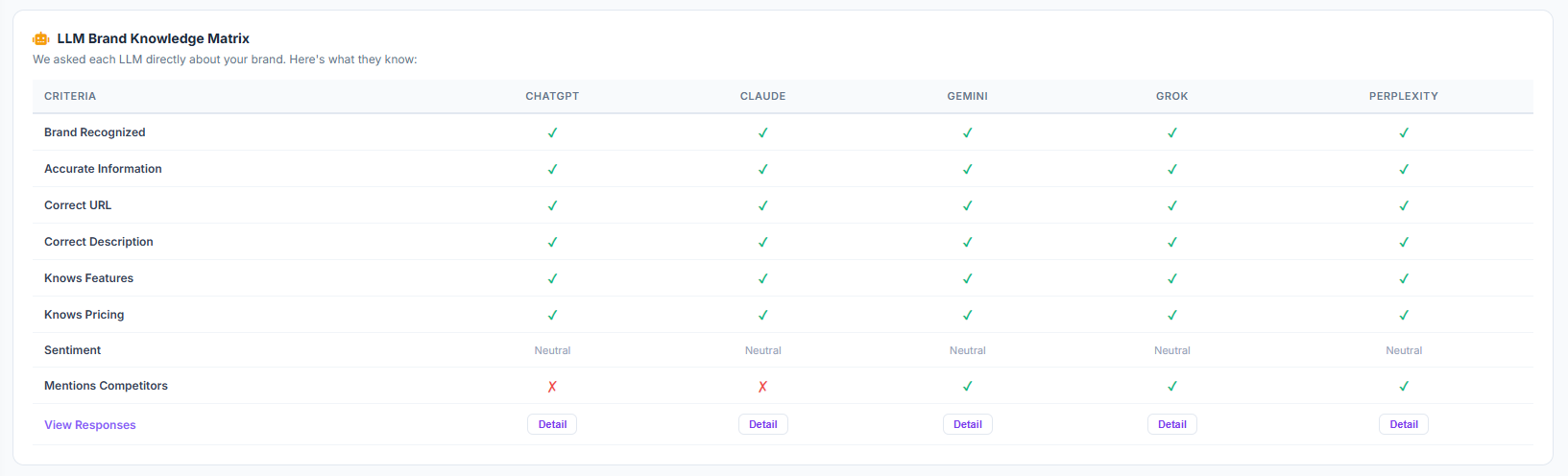
The LLM Brand Knowledge Matrix with criteria rows and per-platform columns.
2. Google SERP Analysis, What LLMs Reference
Header: “We searched Google for the same queries used in your AI Visibility reports.”
The same queries used in your LLM visibility tests are searched on Google to show your position, AI feature presence, and competitor rankings.
Table Columns:
| Column | Description |
|---|---|
| QUERY (FROM LLM TRACKING) | The query from LLM tracking (e.g. “best Status page tool 2026”, “best uptime monitoring 2026”). |
| POSITION | Your Google ranking (N/A, #4, #12, etc.). |
| TOP 10 | Whether you’re in Google’s top 10 results (green check or red cross). |
| AI OVERVIEW | Whether you appear in Google’s AI Overview box. |
| FEATURED SNIPPET | Whether you own the featured snippet. |
| PAA | Whether you appear in People Also Ask. |
| COMPETITORS | Competitors appearing for the same query (e.g. visualping #6, visualping #1). |
| TOP 20 | Button to view the top 20 results (View 9, View 10). |
Strategic Note: This table reveals the data-driven reason why LLMs don’t mention you. If you show N/A in AI Overview and have no SERP features, you’re not generating enough signals for AI to learn from. Competitors consistently appearing at the top of these queries is data that needs monitoring for direct comparison competition.
Product Screenshots
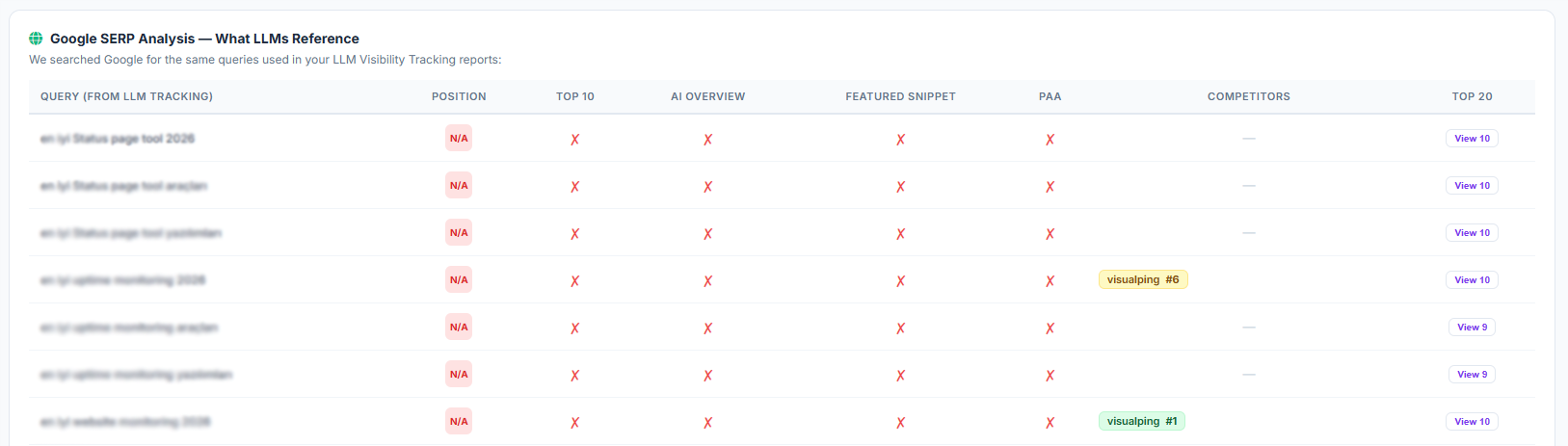
The Google SERP Analysis table showing query positions, AI Overview, Featured Snippet, and competitor data.
 3. Where You Should Appear
Header: “These pages rank in Google for the queries LLMs use. Your brand is missing from them. Getting listed here will directly improve your AI visibility.”
A unified list of pages where your brand is missing but that LLMs reference when generating answers.
Filter Tabs:
| Tab | Description |
|---|---|
| All (63) | All pages where you should appear. |
| Authority Sites (3) | Authority review sites. |
| List & Comparison Pages (60) | Top 10 lists and comparison pages. |
Page Card Content:
| Field | Description |
|---|---|
| Ranking badge (e.g. #10, #7) | The page’s position on Google. |
| Page title (e.g. “The Best Website Monitoring Services”) | Title of the ranking page. |
| Domain (e.g. pcmag.com, capterra.com, g2.com) | The site hosting the page. |
| Label | Authority Site or List/Comparison. |
| Description | Why this page is referenced in AI answers (e.g. “Authority review site, LLMs heavily reference this domain”). |
| Query | Which query this page ranks for (e.g. “website monitoring”). |
Strategic Note: This list provides direct action targets for quickly improving AI visibility. The Authority Sites group (typically 3-5 sites) can be resolved through profile creation or product listing. The List & Comparison Pages group requires outreach (asking the page owner to add you) or producing new comparison content that outperforms the existing competitor list.
Product Screenshots
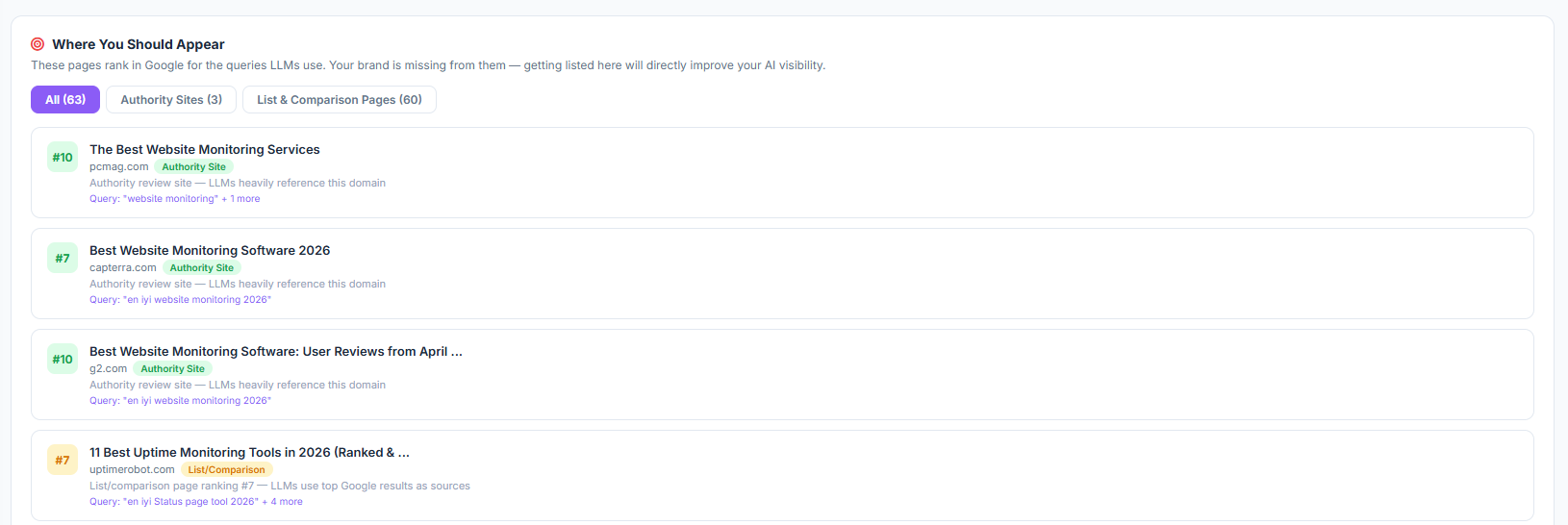
The Where You Should Appear panel with filter tabs and page cards showing ranking, domain, and labels.
4. Optimization Action Plan
An AI-powered panel that converts all the above data into actionable recommendation cards.
Each action card includes:
| Component | Description |
|---|---|
| Priority label | CRITICAL, HIGH, MEDIUM, LOW. |
| Action title (e.g. “Get Listed on Authority Review Sites”) | What to do. |
| Description | What the action will achieve and why it matters. |
| Target resources | Which pages, sites, or content types to target. |
| Time estimate | e.g. 1-2 weeks, 2-4 weeks. |
| Difficulty label | Low, medium, high. |
| Data source badge (e.g. SERP Data) | Which data point this action was derived from. |
Typical Action Categories:
| Category | Description |
|---|---|
| Authority Listing | Create or claim profiles on PCMag, Capterra, G2, and similar authority sites. |
| List Inclusion | Request addition to “Best of” lists or produce content that outranks competitor lists. |
| AI Overview Optimization | Enter Google AI Overview using FAQ schema, E-E-A-T principles, and answer-formatted content. |
| Schema & Structured Data | Implement schema markup so AI can read canonical information. |
| Sentiment Improvement | Move sentiment to positive through customer reviews, case studies, and PR. |
Product Screenshots
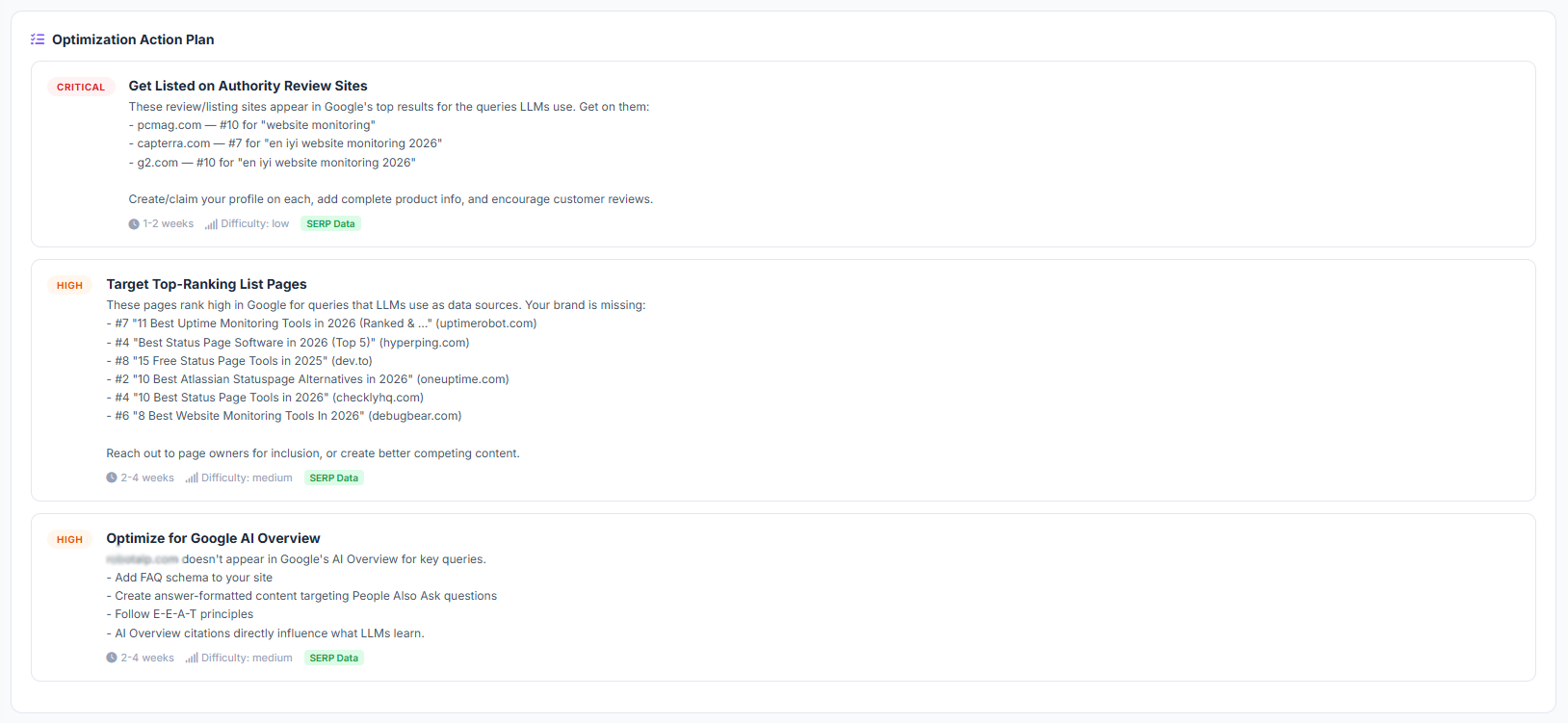
The Optimization Action Plan with prioritized action cards showing difficulty, timeline, and data source.

Full dashboard overview combining all modules in a single view.
 5. Past Checks
An archive of previously run AI visibility tests.
| Field | Description |
|---|---|
| Date | e.g. 16.04.2026. |
| Visibility Score | e.g. 39/100, 49/100. |
| Cost | e.g. 0.02 USD, 0.62 USD. |
Past Checks let you measure the concrete impact of your actions. “I was at 39 three weeks ago, after entering authority listings I’m now at 49” provides objective performance evidence.
 AEO & GEO Explained
AEO (Answer Engine Optimization)
Optimization for answer engines. Strategy for appearing in Google AI Overview, Featured Snippet, People Also Ask, and similar answer boxes. This page directly shows whether you appear in these boxes via the SERP Analysis table and generates an action plan for gaps.
GEO (Generative Engine Optimization)
Optimization for generative AI engines (ChatGPT, Claude, Gemini, Grok, Perplexity). This page measures whether five major LLMs know your brand via the LLM Brand Knowledge Matrix and guides your presence in the source ecosystem AI can learn from via the Where You Should Appear list.
When both approaches are applied together, holistic AI-era visibility is achieved.
 How It Works
| Step | Description |
|---|---|
| 1. Parameter Definition | Select brand, competitors, keywords, and language. |
| 2. LLM Direct Query | Direct brand knowledge queries are sent to five major AI platforms. |
| 3. SERP Query | The same keywords from AI Visibility are searched on Google. |
 4. Knowledge Matrix Generation | A criteria-based knowledge matrix is extracted from LLM responses. |
| 5. SERP Analysis Generation | Google rankings, AI Overview, Featured Snippet, PAA presence, and competitor positions are collected. |
| 6. Where You Should Appear | All authority and list pages where you’re missing are compiled into a unified table. |
| 7. Score Calculation | LLM Knowledge and SERP Presence scores are produced; Overall AI Visibility summarizes into a single metric. |
 8. Action Plan Generation | AI converts all data into prioritized action cards. |
| 9. Archiving | The test is saved to Past Checks with transparent cost display. |
 Use Cases
| Use Case | What You Gain |
|---|---|
| AI SEO Strategy Kickoff | Analyze your brand’s position in the AI ecosystem for the first time. |
| AEO Preparation | Structure content for Google AI Overview, Featured Snippet, and PAA. |
| GEO Operations | Run visibility improvement campaigns across five major LLMs. |
| Authority Listing Operations | Get a task list for profile creation on PCMag, Capterra, G2, and similar sites. |
| List & Comparison Outreach | Plan outreach for inclusion in Top 10 lists. |
 Investment Prioritization | Decide which action to invest in first. |
| AI Hallucination Detection | Catch incorrect information AI provides about your brand. |
| Annual AI SEO Roadmap | Spread action cards across quarterly plans. |
 ShubHQ Integrations
| Integration | How It Connects |
|---|---|
| AI Visibility | Direct source of the query set. |
| SEO Audit | Review site health alongside AI visibility findings. |
| Keyword Opportunities | Review Keyword Opportunities inside Rank Tracker. |
| Rank Tracker | Track the Google keywords you choose to work on. |
Plans & Limits
The plans are Free, Starter and Growth. For current analysis access and allowances, see pricing.
For AI Visibility tracking, Free shows shared sample data, Starter checks tracked questions weekly, and Growth checks daily.
Tips & Best Practices
- Handle Authority Listings first. Profile creation delivers results in 1-2 weeks; the AEO effect is fast.
- Standardize outreach for List & Comparison Pages. Sending templated outreach to dozens of pages is far more efficient than random attempts.
- FAQ schema is essential for AI Overview. A significant portion of Google AI Overview answers are pulled from structured answer-format content.
- Re-run the Brand Knowledge Matrix monthly. AI knowledge bases update regularly; your brand’s position can shift quickly.
- If Sentiment stays Neutral, strengthen your content tone. Customer case studies, PR coverage, and reviews move sentiment to positive.
- Document hallucinations. If AI states wrong URLs or prices, strengthen your canonical data signals (schema, corporate pages).
- Track the competitor column. If the same competitor keeps appearing, producing direct comparison content creates value.
- Measure impact with Past Checks. Re-test after 30 days; score increase is concrete motivation.
- Test in multiple languages. Turkish and English queries produce different results; optimize for both.
The Bottom Line
AI Visibility Optimizer is an end-to-end AI visibility module that measures, analyzes, and optimizes your brand’s position across AEO (Answer Engine Optimization) and GEO (Generative Engine Optimization) layers.
| What You Get | Why It Matters |
|---|---|
| Overall AI Visibility Score | Single-number summary of your combined LLM + SERP visibility |
| LLM Knowledge Matrix | See exactly what each AI model knows (and doesn’t know) about your brand |
| SERP Presence Score | Know whether you appear on the pages AI uses as sources |
| Where You Should Appear | Direct targets for improving AI visibility |
| Optimization Action Plan | Prioritized actions with difficulty, timeline, and data source |
| AI Hallucination Detection | Catch and correct wrong information AI provides about your brand |
| Past Checks History | Track score changes over time and measure action impact |
| Cost Transparency | See USD cost before and after each analysis |
Get Started
Ready to optimize your AI visibility?
- Navigate to AI Visibility Optimizer from your dashboard
- Select your Brand domain
- Add Competitor domains for comparison
- Enter Keywords relevant to your industry
- Choose the Language for analysis
- Click Run Check to start the analysis
- Review your three score cards: Overall AI Visibility, LLM Knowledge, SERP Presence
- Explore the LLM Brand Knowledge Matrix to see what each AI knows
- Check Where You Should Appear for direct action targets
- Follow the Optimization Action Plan for prioritized next steps
Happy optimizing!

Need a hand with this workflow?
Talk to us or explore another guide in the library.