The SaaS Leaky Bucket Problem: How to Detect, Diagnose, and Fix Churn Before It Kills Your Growth
A deep technical guide to identifying and plugging the leaky bucket in SaaS businesses,covering churn signals, cohort analysis, activation failures, and proven retention frameworks backed by data and research.

There’s a concept that separates SaaS companies that scale from those that perpetually struggle: the leaky bucket. You’ve probably heard it referenced in passing,pour users in the top, watch revenue drain out the bottom. But the metaphor is far more precise and actionable than most founders treat it.
In our earlier piece on escaping the early traction plateau, we identified the leaky bucket as one of the two root causes of stalled growth in micro SaaS companies. This article goes deeper: a full technical and strategic breakdown of what causes the leak, how to find it, how to measure it, and,most importantly,how to plug it.
If you’re acquiring users but your MRR isn’t growing proportionally, you’re not facing a growth problem. You’re facing a retention problem. And retention problems are fixable,once you can see them clearly.
What Is the Leaky Bucket Problem in SaaS?
The leaky bucket metaphor describes a fundamental business dynamic: you cannot grow a SaaS company if you’re losing customers faster than you’re acquiring them.
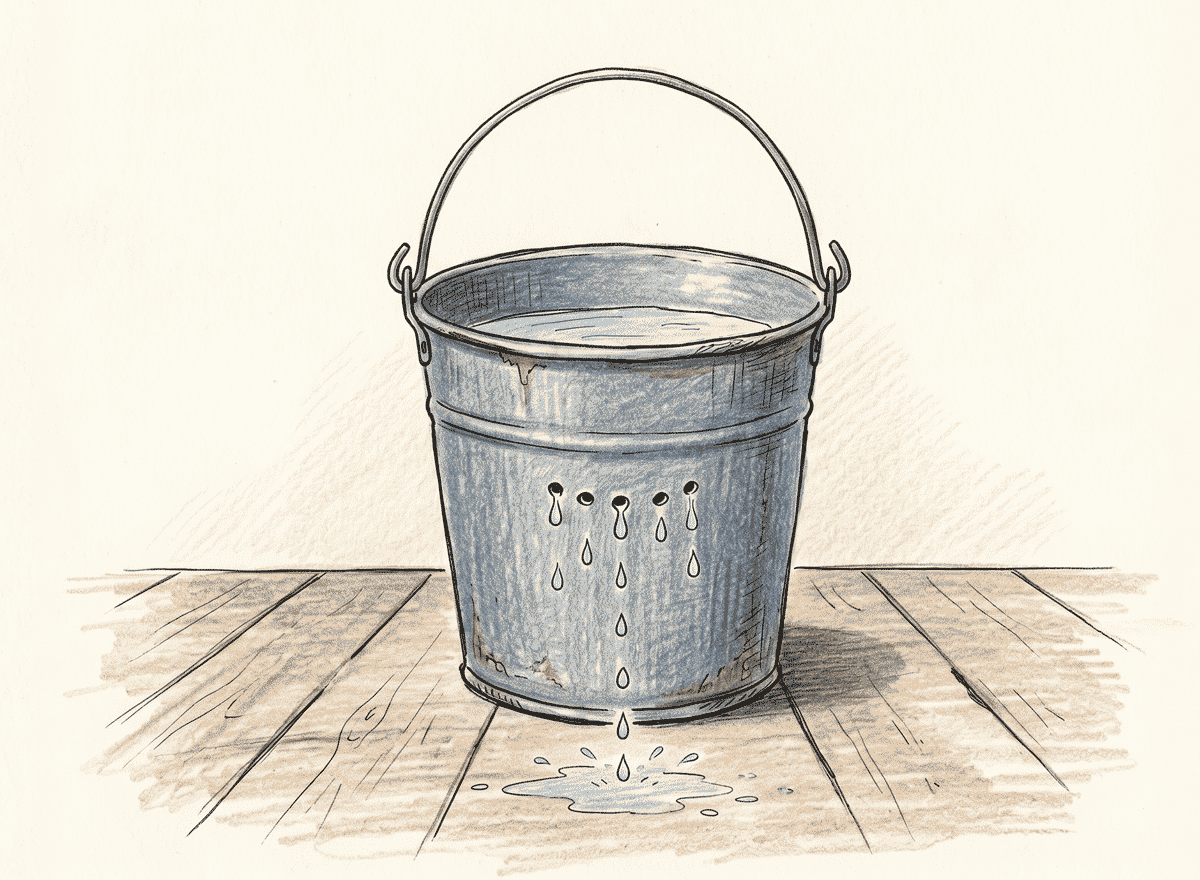
Imagine filling a bucket with water while it has holes at the bottom. You can pour faster, but unless you plug the holes, the bucket never fills. In SaaS terms:
- Water in = new user/customer acquisition
- Holes = churn (cancellations, downgrades, inactivity)
- Water level = your MRR / ARR
The insidious nature of the leaky bucket is that it can appear invisible in early-stage companies. When you’re growing at 20-30% month-over-month, churn is masked by acquisition. But as growth normalizes,and it always does,a 5% monthly churn rate means you’re replacing your entire customer base roughly every 20 months just to stay flat1.
The Math That Should Terrify You
According to ProfitWell’s 2024 SaaS Retention Report, the median monthly churn rate for SaaS companies is approximately 3-5%. At first glance, that sounds manageable. But consider the compounding effect:
| Monthly Churn Rate | Annual Customer Retention |
|---|---|
| 1% | 88.6% |
| 2% | 78.4% |
| 3% | 69.4% |
| 5% | 54.4% |
| 8% | 37.7% |
A company with 5% monthly churn loses nearly half its customer base every year. If your CAC (Customer Acquisition Cost) is $200 and your average customer only stays 4 months, you’re destroying capital with every acquisition dollar you spend.
David Skok’s famous SaaS metrics analysis coined this the “SaaS Quick Ratio”2: a ratio below 4 (new MRR / churned MRR) generally indicates a leaky bucket problem that will eventually cap growth.
Part 1: Detecting the Leak, Signals You Might Be Ignoring
The first challenge is detection. Most early-stage founders either don’t have the instrumentation to see the leak, or they’re watching the wrong metrics. Here are the specific signals to look for.
Signal 1: The Activation Gap
Activation is the moment a user first experiences your product’s core value. It’s not signup. It’s not email confirmation. It’s the first time they say, internally, “Yes, this is why I’m here.”
Research from Intercom’s 2024 Product Benchmarks report found that the average SaaS product activates only 36% of trial users within the first 7 days. That means nearly two-thirds of people who express enough interest to sign up never actually experience your product’s value.
The activation gap is often the largest and most closeable hole in the bucket. If you’re not measuring it, define your activation event right now. Some examples:
- Project management tool: First task assigned to a team member
- Analytics platform: First dashboard with live data
- Email marketing tool: First campaign sent with at least 1 click
- Podcast hosting: First episode published and with at least 10 downloads
Amplitude’s 2024 Product Analytics Benchmark found that users who reach their activation event within 24 hours have 4.3x higher 30-day retention than those who don’t.
Signal 2: Negative Cohort Curves
A retention cohort analysis plots the percentage of users from a given signup month who are still active N days/months later. Healthy SaaS products show retention curves that flatten out,indicating a loyal core of retained users. Leaky bucket products show retention curves that approach zero.
The Benchmark that matters:
- D1 retention: >40% is healthy; <25% is a serious product problem
- D7 retention: >25% is healthy; <15% signals broken onboarding
- D30 retention: >15% is the minimum viable threshold
- M3 retention: Should be at least 40% of M1 retention for B2B SaaS
If your cohort curves don’t flatten, users are finding no ongoing reason to return. This is not a marketing problem,it’s a product-market fit and engagement problem.
Signal 3: Feature Adoption Black Holes
Not all features retain users equally. In most SaaS products, a small subset of features drives the majority of long-term retention. When users fail to discover or adopt these “sticky” features, they inevitably churn.
Mixpanel’s analysis of 1,800 SaaS products found that users who engage with 3+ core features in their first week have 2.7x higher 90-day retention than single-feature users3. This is the breadth-of-adoption signal,and it’s something you can directly influence through onboarding design.
Look at your data and ask: which features do your longest-tenured customers use that newer churned customers didn’t?
Signal 4: Support Ticket Volume Spikes
Support tickets are leading indicators of churn, not lagging ones. A 2023 study by Zendesk found that customers who submit support tickets that go unresolved for more than 24 hours have a 35% higher churn rate within 90 days than those whose issues are resolved quickly.
Track:
- Time to first response
- Resolution rate within 24 hours
- Ticket categories (confusion about features = onboarding gap; repeated issues = product bugs)
- Correlation between ticket categories and subsequent churn
Signal 5: The Login Frequency Cliff
Before a customer cancels, they almost always stop logging in. This behavioral leading indicator,what some call the “pre-churn signal”,typically shows up 14-30 days before cancellation.
Define what “healthy” login frequency looks like for your product. Is it daily? Weekly? Monthly? Then build a cohort of users whose login frequency has dropped below that threshold in the last 14 days. This is your at-risk segment, and it’s actionable.
Part 2: Diagnosing the Leak, Finding the Root Cause
Once you’ve detected that leakage exists, you need to diagnose where in the user journey the holes are. There are five primary locations.
Leak Location 1: Onboarding Failure
Onboarding failure is the single most common and most impactful bucket hole. Samuel Hulick’s research at UserOnboard estimates that 75% of SaaS churn can be attributed to poor onboarding experiences,users who never achieve their desired outcome and quietly disappear.
Onboarding failure typically manifests as:
- Time-to-value too long: More than 5 minutes to experience core value is a red flag for most productivity tools
- Cognitive overload: Showing too many features, options, or decisions before the user has context
- Assumption of knowledge: Skipping explanation of concepts the user needs to understand the product
- Missing success milestones: No clear progress indicators that tell users they’re doing it right
Diagnostic approach: Map your onboarding flow step-by-step. Instrument each step with event tracking. Find the step with the highest drop-off,that’s your biggest onboarding leak. Fix that one step before anything else.
Leak Location 2: Product-Market Fit Misalignment
Sometimes the leak isn’t in your onboarding or your product,it’s in your acquisition. You’re attracting users who were never going to stay, because they’re not your ICP (Ideal Customer Profile).
As discussed in the Early Traction Plateau guide, Transistor.fm’s breakthrough came when they stopped trying to serve “all podcasters” and focused on “SaaS companies that want a podcast.” Their churn rate dropped significantly because their new customers were a better fit.
Signs of ICP misalignment:
- Your churned users cite different use cases than your retained users
- Trial-to-paid conversion is below 15% (industry average is 15-25%4)
- Users say “it’s great, but not quite what I need”
- NPS promoters describe your product very differently than detractors
Diagnostic approach: Survey your top 20% of retained customers and your last 20 churned customers. Ask them: “What were you hoping this product would do for you?” The gap between answers reveals the ICP misalignment.
Leak Location 3: Value Delivery Gaps
Even perfectly onboarded, correctly targeted users churn if the product stops delivering value over time. This is “ongoing value delivery failure”,the product works, but it doesn’t work well enough to justify the continued cost.
Bain & Company’s research found that a 5% increase in customer retention rates increases profits by 25-95%5. The reason is compounding value delivery: customers who stay longer extract more value, expand their usage, and refer others.
Common value delivery gaps:
- No progressive value: The product delivers the same value on day 1 as on day 365,no growth, no improvement
- Feature stagnation: Competitors add features; you don’t; customers compare and leave
- Performance degradation: Product gets slower or buggier over time
- Pricing-value perception gap: The price feels high relative to the perceived value (even if ROI is positive)
Leak Location 4: Competitive Displacement
Sometimes customers leave because they found something better. This is the hardest leak to plug because it requires product work, not just UX/CX work.
Competitive displacement signals:
- Cancellation surveys citing specific competitor names
- Churned users appearing on competitors’ case study pages
- Social listening showing your users praising competitors
- Feature request patterns that exactly mirror a competitor’s offering
Diagnostic approach: Run a win/loss analysis. For every deal you win and every customer you lose, understand why. Tools like Gong, Chorus, or even manual interview calls work here.
Leak Location 5: Pricing and Packaging Mismatch
Pricing is often an underestimated driver of churn. A 2024 OpenView Partners SaaS Benchmarks report found that pricing-related churn accounts for 23% of voluntary cancellations in B2B SaaS6.
This can manifest as:
- Value-metric misalignment: You charge by seats, but customers only have 1-2 heavy users; they feel they’re overpaying
- Growth penalties: Customers churn when they hit a pricing tier that feels punitive
- Annual vs. monthly: Monthly plans have 2-3x higher churn than annual plans
- Freemium-to-paid gap: The free plan is too good; the upgrade triggers aren’t compelling enough
Part 3: Measuring the Leak, The Metrics Framework
You cannot fix what you don’t measure. Here is the complete metrics framework for leaky bucket analysis.
Tier 1: Health Metrics (Check Weekly)
Monthly Churn Rate
Monthly Churn Rate = (Customers Lost in Month / Customers at Start of Month) �, 100Target: <2% for B2B SaaS, <5% for SMB-focused tools7
Net Revenue Retention (NRR)
NRR = (Starting MRR + Expansion MRR - Churned MRR - Contraction MRR) / Starting MRR �, 100This is the single most important retention metric. Best-in-class SaaS companies achieve >120% NRR, meaning expansion revenue from existing customers exceeds lost revenue from churn8.
Quick Ratio
Quick Ratio = (New MRR + Expansion MRR) / (Churned MRR + Contraction MRR)A ratio above 4 is healthy. Below 4 suggests the bucket is leaking faster than you’re filling it.
Tier 2: Leading Indicators (Check Monthly)
Activation Rate
Activation Rate = Users Who Hit Activation Event / Total Signups �, 100Benchmark: 40%+ within first 7 days
Time to Value (TTV)
TTV = Average time from signup to first activation eventMinimize this aggressively. Every hour of delay is a retention risk.
DAU/MAU Ratio (Stickiness)
Stickiness = Daily Active Users / Monthly Active Users �, 100World-class consumer apps hit 50%+. Solid B2B SaaS: 25-40%. Below 10% is a serious engagement problem.
Feature Adoption Rate
Feature Adoption Rate = Monthly Active Users of Feature / Total Active Users �, 100Track this per feature. Features below 10% adoption are either unnecessary or undiscoverable.
Tier 3: Diagnostic Metrics (Check on Churn Spikes)
Cohort Retention by Acquisition Channel: Different acquisition channels produce users with different retention profiles. Paid traffic users often churn faster than organic/referral users. Know your channel-specific retention.
Churn by Plan/Tier: Are free users churning? Paid users churning? Which plan? This diagnoses pricing and value delivery issues.
Churn by Use Case / Segment: If one segment (e.g., solo founders) churns at 2x the rate of another (e.g., small teams), you have a targeting or product-fit issue in that segment.
Part 4: Plugging the Leak, The Intervention Playbook
Now for the actionable part. Here are evidence-based interventions for each leak type.
Intervention 1: Rebuild Onboarding Around Outcomes, Not Features
The #1 onboarding mistake is giving users a product tour instead of guiding them to their first outcome. Users don’t want to know what buttons do,they want to solve their problem.
The JBTD Onboarding Framework (Jobs-to-be-Done):
- At signup, ask: “What are you hoping to accomplish?” (2-3 choices max)
- Route users to personalized onboarding tracks based on their answer
- Each track’s goal: get the user to their first outcome in <5 minutes
- Celebrate the moment they achieve it (confetti, confirmation message, email)
Appcues’ analysis of 1,000 SaaS onboarding flows found that personalized onboarding increases activation rates by 40-60% compared to generic tours.
The Empty State Problem: Most SaaS products show empty dashboards to new users. This is a missed opportunity. Fill empty states with templates, examples, or sample data. Canva pre-fills with beautiful templates. Notion shows pre-built wikis. Show users what success looks like before they’ve built anything.
Intervention 2: Build a Churn Prediction Model
You don’t need machine learning to build a basic churn prediction model. A simple rule-based system works for most micro SaaS companies:
Risk Score Components (weight each 1-3):
- Login frequency below weekly threshold: +3
- Feature usage dropped by >50% vs. last month: +3
- Support ticket unresolved >48h: +2
- No usage of any “sticky” feature in 14 days: +2
- Plan not upgraded after 60 days on free: +1
Users with a risk score of 6+ are at high churn risk. Trigger an automated intervention:
- Personalized email from the founder or CSM
- In-app notification offering help
- Offer to do a live walkthrough call
Companies using proactive churn intervention see 15-30% reduction in voluntary churn9.
Intervention 3: The Churn Exit Interview Protocol
Every churned customer is a gold mine of diagnostic information. The problem is most companies either don’t ask at all, or they ask through a cancellation survey with generic options like “too expensive” or “found a better solution”,which tells you almost nothing.
The 5-Minute Churn Interview:
Send this email within 2 hours of cancellation:
Subject: Quick question before you go
Hi [Name], I noticed you cancelled your account. I’m not going to try to win you back,I just want to understand what happened so I can make [Product] better.
Would you be willing to answer one question?
“What was the #1 thing [Product] didn’t do that you needed it to do?”
Nothing else. Just that one question. You can reply in one sentence.
This approach, documented by Patrick Campbell at ProfitWell, achieves 40-60% response rates,far higher than traditional cancellation surveys10.
Aggregate 20+ of these responses and you’ll see patterns that would take months of A/B testing to discover.
Intervention 4: Implement Lifecycle Email Automation
Email remains the highest-ROI retention channel for SaaS. A properly sequenced lifecycle email program can meaningfully reduce churn at each stage of the user journey.
The Retention Email Stack:
Day 0, Welcome: Confirm signup, set expectations for what happens next. Mention the one thing to do first. Response rate benchmark: 60%+ opens
Day 1, Activation nudge: If they haven’t hit the activation event, send a specific action prompt. “You’re 1 step away from [value].”
Day 3, First value story: Case study or example of a customer who achieved success. Builds confidence that the product works.
Day 7, Progress check: “How are things going? You’ve done X. Here’s how to do Y next.”
Day 14, Power user feature: Introduce a sticky feature they likely haven’t discovered yet.
Day 30, Feedback request: NPS survey or simple “What’s one thing we could do better?”
Day 60+, Expansion trigger: If they’re on free or starter plan, introduce a feature or case study that illustrates the upgrade value.
Intercom’s analysis found that lifecycle email sequences reduce Day-30 churn by 22% compared to single welcome emails.
Intervention 5: Fix Your Pricing Architecture
If pricing-related churn is significant (>15% of cancellations cite price), you likely have a structural pricing problem, not just a perception problem.
Evidence-based pricing interventions:
Shift to value metrics: Charge based on the value users extract, not just seats. HubSpot charges by contacts; Intercom charges by monthly active users; Loom charges by video views. When the pricing metric aligns with value delivery, customers feel fair,and stay longer.
Introduce annual plans with real incentives: Offer 15-20% discount for annual billing. This reduces churn to near-zero for those cohorts (they’ve paid; they’re committed) and improves your cash flow. OpenView reports annual plan customers have 65% lower churn rates than monthly customers11.
Design your free-to-paid upgrade moment carefully: The best upgrade triggers are not time-based,they’re usage-based. When a user hits a limit or tries to access a feature that would give them clear additional value, that’s the moment to prompt an upgrade. Not after 14 days regardless of behavior.
Intervention 6: Build Product Stickiness Through Integrations and Data Lock-in
The most durable retention comes not from preventing cancellation but from making your product genuinely hard to leave,through the value it accumulates over time.
Strategies:
- Data accumulation: Historical data, reports, and analytics that become more valuable over time (no one wants to abandon 18 months of their own data)
- Integrations: Every integration a customer sets up increases switching cost. Zapier reports that customers with 3+ integrations have 50% lower churn than customers with none
- Collaboration network effects: Products used by teams create social lock-in; cancelling affects multiple people
- Customization: Templates, saved settings, custom workflows,personalization that users don’t want to rebuild
Part 5: The Retention Stack, Tools and Infrastructure
Running effective retention operations requires the right tooling. Here’s what a pragmatic micro SaaS retention stack looks like at different stages.
Stage 1: $0-$5k MRR, The Lean Stack
At this stage, you need signal, not automation.
- Analytics: Posthog (free tier) or Mixpanel (free tier), event tracking and cohort analysis
- Email: Customer.io or Loops, lifecycle email automation triggered by events
- Feedback: Typeform or Tally, cancellation surveys and NPS
- Session replay: Hotjar or Microsoft Clarity (free), see exactly where users get confused
Total cost: $0-$100/month. No excuses.
Stage 2: $5k-$50k MRR, The Growth Stack
Now you need to operationalize retention.
- Customer success platform: Intercom or Crisp, in-app messaging + lifecycle automation
- Churn prediction: ChurnKey or Baremetrics, automated churn risk scoring
- NPS tracking: Delighted or Wootric, systematic feedback loops
- Revenue analytics: Chartmogul or Baremetrics, cohort MRR analysis
Stage 3: $50k+ MRR, The Scale Stack
- Full CRM with health scoring: HubSpot or Salesforce + custom health score
- Product analytics: Amplitude or Mixpanel paid tier, advanced behavioral cohorts
- In-app engagement: Pendo or Appcues, contextual onboarding and feature announcements
- Dedicated churn prevention: Chargebee Retention (formerly Brightback), intelligent cancellation flows
Case Studies: Companies That Plugged the Leak
Case Study 1: Groove HQ, Onboarding Rebuild
Alex Turnbull, founder of Groove (help desk software), documented publicly how their churn rate dropped from 4.5% to under 1.5% monthly after a complete onboarding overhaul12.
The key changes:
- Replaced the generic product tour with a guided setup wizard focused on “your first conversation resolved”
- Added a progress bar to make users feel momentum
- Sent behavior-triggered emails when users stalled at specific steps
- Removed features from the onboarding that weren’t critical to Day-1 value
Result: Activation rate went from 27% to 61%. The improved activation directly corresponded with the churn reduction.
Case Study 2: Baremetrics, Pricing Architecture Fix
Baremetrics (SaaS analytics) noticed a pattern: customers who upgraded from monthly to annual billing almost never churned, while monthly customers churned at 3-4x the rate. They made annual billing more prominent, added clearer incentives, and redesigned the upgrade flow.
Within 6 months, annual plan penetration went from 35% to 62%. Monthly churn dropped by 28% as a result.
Case Study 3: Wistia, Feature Adoption and Stickiness
Wistia (video hosting) discovered through cohort analysis that customers who used their “Channels” feature (organized video series) had 4x lower churn than those who didn’t. Yet only 12% of customers used Channels.
They made Channels more discoverable in onboarding and added a specific email in their lifecycle sequence about it. Feature adoption rose to 31%. Annual churn dropped from 22% to 14%.
Building a Retention Culture: The Organizational Side
Plugging the leaky bucket isn’t just a product or marketing problem,it’s a cultural and organizational one. The best SaaS companies treat retention as a company-wide metric, not just a customer success function.
The Retention Review Cadence
Weekly: Review active users, login trends, support ticket volume. Flag at-risk accounts.
Monthly: Full cohort analysis. What are the M1, M3, M6 retention rates for each signup cohort? Which cohorts are outliers (positive or negative) and why?
Quarterly: Churn root cause analysis. Categorize every cancellation from the quarter. What percentage was due to onboarding failure, fit issues, competitive displacement, pricing, or life events? Prioritize the top category for next quarter’s fix.
The NPS to Action Loop
Net Promoter Score is only useful if it drives action. Build the loop:
- Send NPS survey at Day 30 and quarterly thereafter
- Categorize responses by theme (not just score)
- Promoters (9-10): Ask for referrals, case studies, testimonials
- Passives (7-8): Identify the one thing that would make them a promoter; often it’s a missing feature
- Detractors (0-6): Personal outreach within 24 hours; understand their specific frustration; create tickets for product team
Companies with a systematized NPS to Action loop see NPS improvement of 20+ points within 12 months of implementation, which strongly correlates with churn reduction.
The Leaky Bucket Audit: Your 2-Week Action Plan
If you’ve read this far and suspect your bucket is leaking, here’s a prioritized 2-week audit:
Days 1-3: Instrument and Measure
- Instrument your activation event in your analytics tool if not already done
- Pull a cohort retention chart for your last 6 months of signups
- Calculate your actual monthly churn rate (churned customers / starting customer count)
- Pull your DAU/MAU ratio
Days 4-7: Diagnose
- Map your onboarding flow step-by-step; find the biggest drop-off point
- Send the 5-minute churn interview email to your last 30 churned customers
- Run a feature adoption analysis: which features do churned vs. retained customers use differently?
- Check your pricing: what % of cancellations cite price?
Days 8-11: Fix the Biggest Leak First
- If activation rate is below 40%: redesign the onboarding for the highest drop-off step
- If churn interviews reveal a product gap: prioritize that feature
- If pricing is cited in >15% of cancellations: consider annual plan incentives or value metric shift
- If engagement is low: launch a lifecycle email sequence
Days 12-14: Set Up the Measurement Loop
- Build a weekly dashboard with your Tier 1 health metrics
- Set up at-risk user alerts (login frequency drops)
- Schedule monthly cohort review sessions
- Define your activation event and track it weekly
Final Thoughts
The leaky bucket is not a metaphor for laziness or poor product quality. It’s an inherent feature of the SaaS business model,one that the best companies have learned to manage systematically rather than panic about reactively.
The founders who scale past the early traction plateau,as explored in our companion article,are the ones who stopped treating churn as an embarrassing failure and started treating it as diagnostic data.
Every churned customer tells you something. Every activation drop-off shows you where users lose faith. Every feature never adopted reveals a discovery or value gap. The data is there. The only question is whether you’re listening to it.
Plug the leaks. Then pour water.
References
Footnotes
-
Skok, D. (2024). “SaaS Metrics 2.0: A Guide to Measuring and Improving What Matters”. For Entrepreneurs / Matrix Partners ↩
-
“SaaS Quick Ratio”. Wall Street Prep ↩
-
“2025 SaaS Benchmarks Report”. HubSpot ↩
-
“Feature Adoption and Retention”. Theseus ↩
-
“2026 B2B SaaS Conversion Benchmarks”. SaaSHero ↩
-
Reichheld, F. & Schefter, P. (2000). “E-Loyalty: Your Secret Weapon on the Web”. Harvard Business Review ↩
-
“2024 SaaS Benchmarks Report”. High Alpha ↩
-
“What is Churn Rate: How to Calculate and Reduce Customer Loss”. CustomerScore ↩
-
Bessemer Venture Partners (2024). “State of the Cloud 2024”. BVP ↩
-
Sahu, K. “Proactive vs. Reactive Customer Success: Striking the Right Balance”. LinkedIn ↩
-
“Churn Analysis in SaaS: How to Find Patterns and Fix Retention”. CustomerScore ↩
-
“How to Calculate Churn the Right Way”. Ordergroove ↩