 Aydın Nasuh
I asked AI for the best SaaS growth tools. ChatGPT, Claude, Gemini, Grok and Google all gave me the same kind of answer: Semrush, Ahrefs, SE Ranking. SEO suites. Not one growth tool.
My product, ShubHQ, is a growth tool. So that’s when I saw the real problem. AI had no shelf to put it on.
Positioning used to be written for buyers. Today AI reads it first. It decides which shelf your product goes on. If it picks the wrong shelf, or can’t pick one, you’re not in the answer.
This post has two cases. The first is a 7-year-old SaaS that let me analyse its data. The second is my own, ShubHQ, six months old. Both got their category wrong. Neither saw how far the mistake spread: into the homepage, the product pages, the blog and every directory profile.
The short version
- A category is a shelf
- AI and Google sort products onto shelves. If your category is vague, they pick one for you.
- Test before you choose
- Ask AI your buyer questions. Check who ranks on Google: tools, agencies or blog posts?
- Door and promise
- Put the category word where machines read. Put your promise where people read.
- One slot
- Finish the sentence "best for ___". One audience. Say who it's not for.
- It's every page
- Title, homepage, product pages, blog, directories. All say the same sentence.
What a category does now
When someone asks AI for “the best X”, it doesn’t invent a list. It leans on the “best X tools” articles it has read or can find. Those articles are written in slots: best for agencies, best free option, best for startups.
So two things decide whether you show up:
- Your category word decides which lists you can be in.
- Your audience decides which slot you can take in those lists.
Google reads the same signals. If your pages say five different things, Google files you under the one it sees most. That’s often not the one you chose.
Four layers of positioning
| Layer | Question | Example | Changes |
|---|---|---|---|
| Category | What are you? | AI visibility and growth tool | Rarely. This is the word AI and Google search with. |
| Audience | Who is it for? | Solo SaaS founders, no growth team | No. This is your slot in the lists. |
| Difference | Why you? | Gives this month's plan and checks if it worked | The focus can shift by channel. The core stays. |
| Proof | Why believe it? | Research, own numbers, panel data | It grows over time. |
Case 1: seven years, twelve tools, three shelves
The first case is an uptime monitoring SaaS. It’s seven years old and has thousands of users. Its owner gave me permission to analyse the data. I’m not naming it.
The product is good, and it does a lot. It has 12 tools inside: uptime checks, ping, server monitoring, change monitoring, status pages, blacklist checks and more. The site describes it in three ways at once:
- an uptime monitoring tool
- a website monitoring tool
- a status page tool
For the owner, these are the same thing. For AI, they aren’t.
Similar words, different shelves
ShubHQ runs “best tools” lists for many categories through AI engines. Two of them were “website monitoring” and “uptime monitoring”. I expected the same tools in both. The tool lists came back different.
To you, the two words are synonyms. To AI, they’re two shelves with two sets of leaders. Status pages are a third shelf with their own leaders. A tool that spreads itself across all three competes on each one at a third of its strength.
What AI does with it
In AI answers, the tool is almost absent. Across six engines and four buyer questions it was named once, at #38 in a long list. In the “best”, “alternatives” and “small teams” questions it doesn’t appear at all. I wrote up those numbers in the LLM visibility post.
What Google does with it
Google has filed it under its side features, not its core.
Google positions: core terms vs. side features
- website uptime monitoringcore#78
- uptime monitoringcorenot in top 50
- status pagecorenot in top 50
- best website monitoring toolscorenot in top 50
- website monitoringcore#42
- free website monitoringcore, long-tail#19
- open source status pageside#24
- blacklist monitoring serviceside#9
- open source price trackeroff-topic#5
See it in the ShubHQ panel
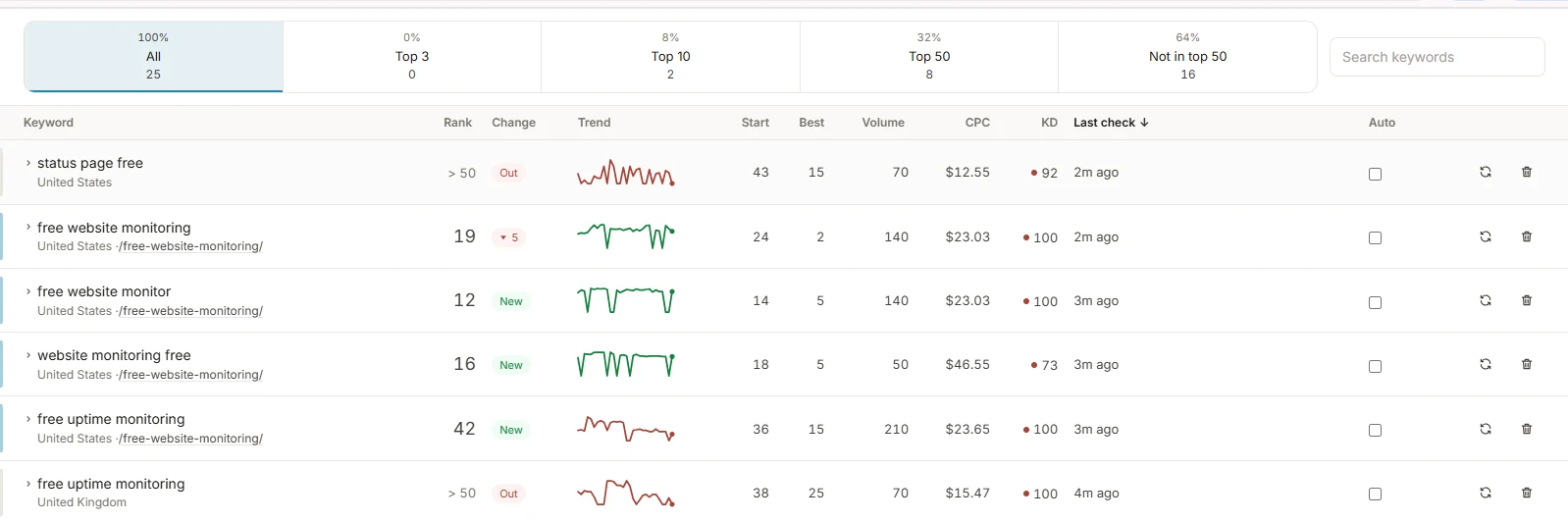
AI uses web search for many answers, and it reads the top results. If your core term sits at #78, AI doesn’t see you there.
The blog went somewhere else
Over the years, the blog covered price trackers, password generators, Zapier alternatives and Kubernetes. Some of those posts brought traffic and links. None of them told Google or AI “this is an uptime monitoring tool”.
The tool still tracks price-tracking keywords. It ranks #5 for “open source price tracker”. It’s outside the top 50 for every price-tracking term people actually search for.
See the full table

Links from those posts came in. The link between the brand and its category didn’t.
What it could do
The data already shows two slots it could own:
- Status pages for agencies: many of its links come from customers’ status pages.
- Monitoring for online stores: there’s a clear trace of WooCommerce and store owners in its users.
Either one is a “best for ___” slot that the current lists don’t fill well. Picking one doesn’t mean deleting the other 11 tools. It means leading with one sentence.
There’s also an opening any monitoring tool could take. Freshworks shut down Freshping in March 2026. ChatGPT, Claude and Gemini still recommend it in almost every answer. A clear “Freshping alternative” page answers a question AI is still getting wrong.
Case 2: ShubHQ, a product between three categories
My own case is the opposite problem. The 7-year-old tool sits in a clear category and spreads too wide. ShubHQ sits between categories.
ShubHQ: a SaaS growth tool
- LLM visibility tools
- AI SEO tools
- Rank tracking
- Backlink analytics
- SEO audit
- Keyword research
- AI growth agent
- AI chat on your data
- Monthly growth plan
- Measures what worked
ShubHQ does what LLM visibility tools do: tracking, optimization and AEO. It does what AI SEO tools do: rank tracking, backlink analytics, SEO audits, keyword research. And it does something neither does: an AI chat that works on your project data, plans your month and measures what worked.
So what do you call it? Here’s how I got it wrong first.
Attempt 1: a name for a category nobody searches
In August, the homepage said “Your AI Growth Operator for SaaS & E-commerce”. Eight modules. Two audiences.
No list has an “AI growth operator” row. Nobody types it into Google or ChatGPT. And “SaaS and e-commerce” is two slots, so it fits neither.
Attempt 2: “SaaS growth tools”
This is what ShubHQ really is. So I tested it.
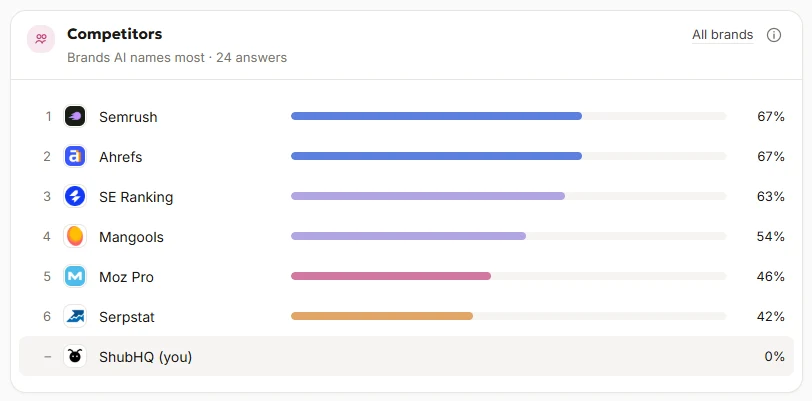
AI reads “SaaS growth tools” as SEO tools. Google reads “SaaS growth” as something else again. Page one is benchmark reports, agencies, funds and strategy lists. Hardly any tools.
That pattern repeats. When I searched “SaaS positioning” for this post, most of page one was agency pages. Agencies fill the broad SaaS terms because they sell the service, not a tool.
What Google already thought
Search Console told me where Google had already put ShubHQ. It matched the site to “llm visibility” and “backlink analytics”, not to growth. My free LLM visibility checker now ranks #18 for “llm visibility checker”. My growth pages aren’t in the top 50 for anything.
Google had picked a shelf for me. It wasn’t wrong. It just wasn’t the shelf I wanted.
The decision: door and promise
I stopped trying to make one word do two jobs.
The door: AI visibility
The category word. It goes where Google, AI and list writers read.
- Page title and meta description
- The line above the homepage H1
- Schema markup
- Directory profiles
- Social bios
The promise: SaaS growth
What the founder actually wants. It goes where people read.
- Homepage subheading
- Product tour
- FAQ answers
- Posts and replies
A new SaaS founder doesn’t wake up wanting to be in a ChatGPT list. They want their first users. So AI visibility is how people find ShubHQ, and growth is why they stay.
The slot: best for solo SaaS founders. The AI visibility lists already have best for enterprise, best for agencies and best budget option. Nobody owns the solo founder.
The sentence, now used everywhere, word for word:
ShubHQ is an AI visibility and growth tool for solo SaaS founders. It checks whether ChatGPT and Google recommend you, then gives you this month’s plan and measures if it worked.
The first half uses words people and AI already use. The second half is the difference.
One decision, every page
This is the part I didn’t expect. Choosing the category was one decision. Applying it touched almost every page on the site.
What changed on shubhq.com after the category decision
| Area | Before | After |
|---|---|---|
| Line above the homepage H1 | The path to $1,000 MRR | AI visibility and growth for solo SaaS founders |
| Audience | SaaS and e-commerce founders, agencies, growth teams | Solo SaaS founders only. Agencies and enterprise SEO teams are listed as "not for". |
| E-commerce page | In the main menu | Removed and redirected |
| Homepage tool cards | A separate Backlinks card | Removed. Links now sit inside one "Authority" step. |
| Product pages | Three retired modules still had their own pages | Redirected to Growth OS |
| Guides | "Planned modules" sections described features that weren't live | Removed |
| Hub lists | General categories like CRM and project management, in the main menu | 11 growth-stack lists, in the footer |
| Directory profiles | Old description on about 25 profiles. One described ShubHQ as a logistics company. Another listed 24/7 phone support. | One sentence, rewritten on every profile (in progress) |
| Blog | General SEO tips | AI visibility for small SaaS, first customers, my own numbers |
At the time, none of this looked like a positioning problem. Each item looked like a small copy fix. Together, they were telling Google and AI a different story on every page.
The directory one hurt most. I didn’t write “logistics company” anywhere. The profile’s description field was weak, and something filled the gap. If you don’t state what you are, someone or something will state it for you.
The page AI actually quoted
One more finding changed how I write product pages.
In 90 days, ChatGPT sent 11 visitors to shubhq.com. Eight of them landed on the careers page. Not the homepage. Not a product page.
The careers page was the only page that said, in plain sentences, what the company is: its name, its category, what it’s built with, where it is. Every product page was written to persuade. The careers page was written to state facts.
So I’m adding one plain paragraph to the top of every product page: what it is, who it’s for, what it does. The sales copy comes after.
How to pick your category: 7 steps
List your candidate words
Write 3–5 words someone might use for your product. Include the one you like and the ones your buyers actually say.
Test each word in AI
Ask four questions per word: best, alternatives, best for small teams, and a long list. Use several engines. If the tools named do something else, AI reads the word differently from you.
Test each word in Google
Look at page one. Tools and "best X" lists mean there's a shelf you can join. Agencies, benchmarks and essays mean there's no tool shelf yet.
Check where Google already put you
Open Search Console. Which queries bring impressions? That's the shelf Google picked for you. Decide if you'll use it or move.
Pick the door
Choose the word with a real shelf that's close to what you do. It doesn't have to describe your whole product.
Pick your slot
Finish "best for ___" in five words or fewer. One audience. Then write who it's not for.
Write one sentence and copy it everywhere
Category first, difference second. Same words in the title, meta, homepage, schema, every directory and every bio. Then ask the same AI questions again in a month.
You can run step 2 by hand. Or use the free LLM visibility checker for a quick look, and AI Visibility to ask the four questions every week.
Signs your category is wrong
If two or more are true, start with positioning, not content
- AI names tools that do something else when you ask about your category.
- You rank well for side features and badly for your main term.
- Your homepage speaks to more than one audience.
- You can't finish "best for ___" in five words.
- Your directory profiles describe you in different ways.
- Your best blog traffic comes from topics you don't sell.
- You found out by accident that someone described your product wrongly.
Where I am
ShubHQ, November 2026
- Category chosen
- 19 October 2026: AI visibility (door), SaaS growth (promise)
- Slot
- Best for solo SaaS founders
- Site
- Homepage, product pages, Hub and blog being updated
- Directories
- Rewriting about 25 profiles with the new sentence
- AI visibility
- 0% today. Launch is on 10 December.
I'll report whether the new category moved anything in the 8-month update of the LLM visibility post.
The 7-year-old tool shows what happens when you wait. Years of work, thousands of users, and AI still doesn’t know which shelf it belongs on. ShubHQ is six months old, so I’m fixing the category before it has years of mixed signals behind it.
If you take one thing from this post: decide your shelf on purpose. Otherwise AI and Google will decide for you.
Check how AI reads your category. Run the free LLM visibility checker, no signup. Or create a free account and track your category’s four buyer questions over time.
Sources
- ShubHQ AI Visibility and Rank Tracker, own project data and an anonymous 7-year-old uptime monitoring SaaS (with the owner’s permission), September–November 2026
- ShubHQ Search Console and analytics data, 2026
- Notifier: Freshping has shut down