 Aydın Nasuh
More buyers now ask ChatGPT or Google’s AI before they ever see a search result. “What’s the best tool for X?” The answer names three to ten products. If yours isn’t one of them, you don’t get the click, and you don’t even see that you lost it.
LLM visibility tools show you that missing part. Below is what they measure, what to look for, and eight tools that are each good at something different.
What is LLM visibility?
LLM visibility is how often AI assistants mention or recommend your brand. You’ll also see it called AI visibility, or AI search visibility. Same thing.
AI assistants get brand names from two places:
Training data. What the model learned before it shipped. This is months old. A tool that launched last year may not exist for the model yet.
Live web search. ChatGPT, Perplexity and Google’s AI features search the web while they answer, and they cite the pages they used.
Most of those cited pages aren’t your own site. They’re review sites, Reddit threads, YouTube videos and “best tools” articles. That’s why LLM visibility is mostly about what other sites say about you. I go deeper into this in How to Improve LLM Visibility for Your SaaS.
What a good tool should track
Before you pick a tool, check that it covers these
- Mention rate: the share of AI answers that name your brand.
- Position: where you appear in the list, not just whether you appear.
- Competitors: who gets named when you don't.
- Sources: which pages AI cited for those answers.
- More than one engine: ChatGPT alone is a small part of the picture.
- Trend over time: a weekly line, not a single snapshot.
One thing surprises most people the first time they look. Each AI gives a different answer. A tool can be in every Claude answer and in none of Google AI Mode’s. So the engines a tool covers matter as much as its features.
The 8 best LLM visibility tools
| Tool | Best for | Starts at |
|---|---|---|
| Semrush AI Visibility Toolkit | Teams already on Semrush | $99/mo |
| Ahrefs Brand Radar | Research across a huge set of AI answers | $199/mo per AI index |
| Profound | Enterprise AI visibility and marketing workflows | Custom (free trial) |
| Peec AI | Agencies and multi-brand teams | $95/mo |
| Otterly.AI | Small budgets, simple setup | $29/mo |
| ShubHQ | SaaS founders who want LLM visibility and SEO in one place | $15/moFirst 3 months on launch offer, free plan available |
| Scrunch | AI visibility reporting and site audits | $250/mo |
| Clearscope | Content teams | $129/mo |
Want to see which of these tools AI assistants actually recommend? See the monthly AI ranking.
1. Semrush AI Visibility Toolkit
- Best for
- Teams that already live in Semrush
- Starts at
- $99/mo
| Pros | Cons |
|---|---|
|
|
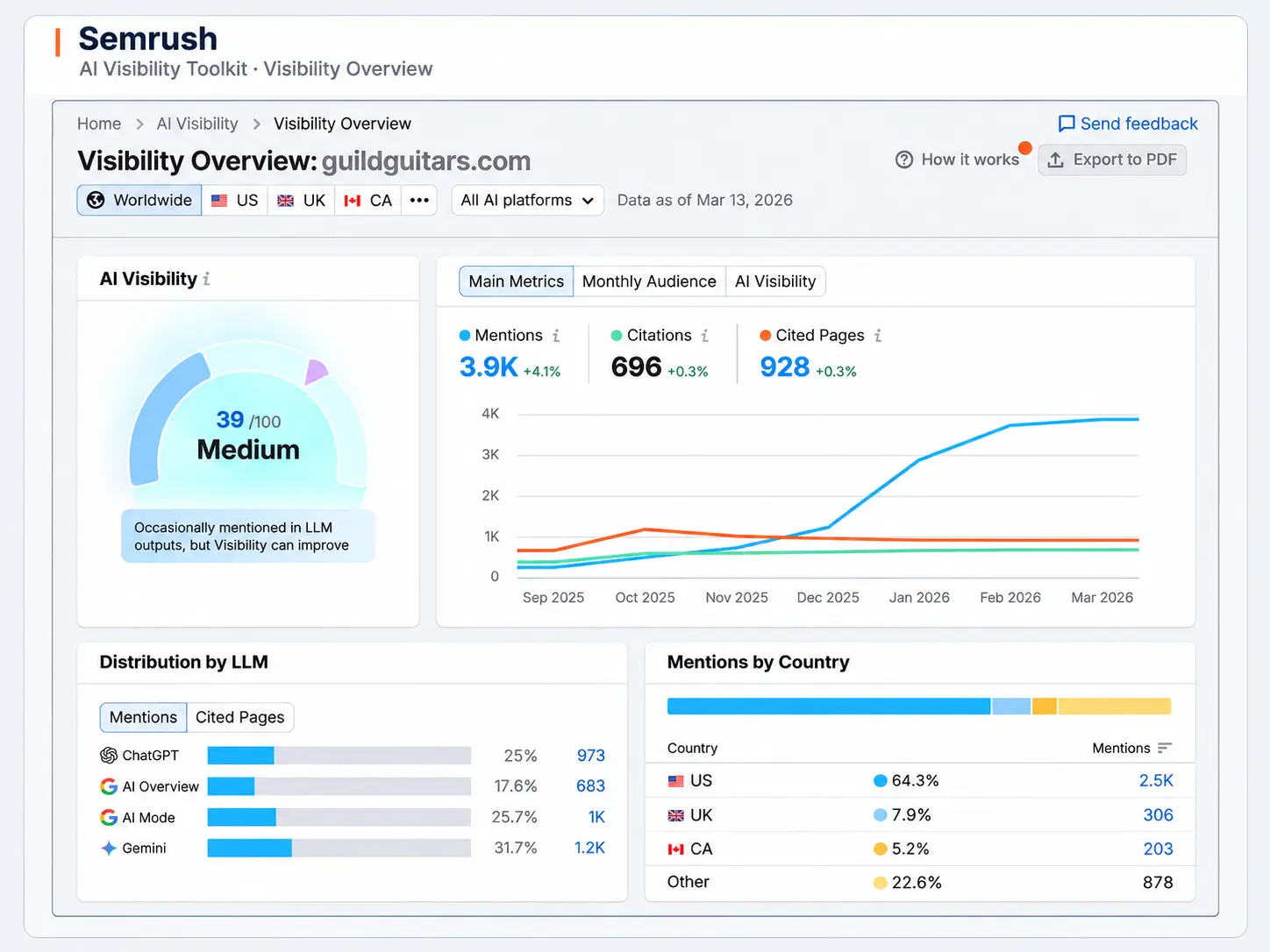
If your SEO reporting is already in Semrush, this is the easiest add. The toolkit is included in every Semrush One plan. You can also buy it alone as AI Visibility Base, or add it to an existing SEO Classic subscription as a paid add-on.
Semrush plans that include AI visibility
| Plan | Billed monthly | Billed yearly | Daily prompts |
|---|---|---|---|
| AI Visibility Base Standalone | $99 | Not listed | 25 |
| Semrush One Starter | $199 | $165.17 | 50 |
| Semrush One Pro+ | $299 | $248.17 | 100 |
| Semrush One Advanced | $549 | $455.67 | 200 |
The 25 prompts on Base are your own list, measured again every day. That’s enough for a focused set of buyer questions, not for a big brand with many product lines.
The limit is less tight than it sounds, though. Base also gives you 300 AI Analysis and 1,000 Prompt Research queries a day on Semrush’s ready-made data, so you can research competitors and topics without using up your 25 prompts.
- Visibility and competitors: how often your brand appears in AI answers, your share of voice, and where competitors show up instead.
- Prompt Research and Tracking: find questions worth tracking, with volume and intent, then check your own list every day.
- AI Search Site Audit: technical issues that may stop AI bots from crawling your site.
Engine coverage depends on the report. Semrush’s pricing page lists brand mention data from ChatGPT, Google AI, Gemini and Perplexity. Its help docs give ChatGPT and Google AI Mode as the examples for daily prompt tracking. Check which engines you get in the report you care about most.
2. Ahrefs Brand Radar
- Best for
- Competitive research across a large index of AI answers
- Starts at
- $199/mo per AI index
| Pros | Cons |
|---|---|
|
|
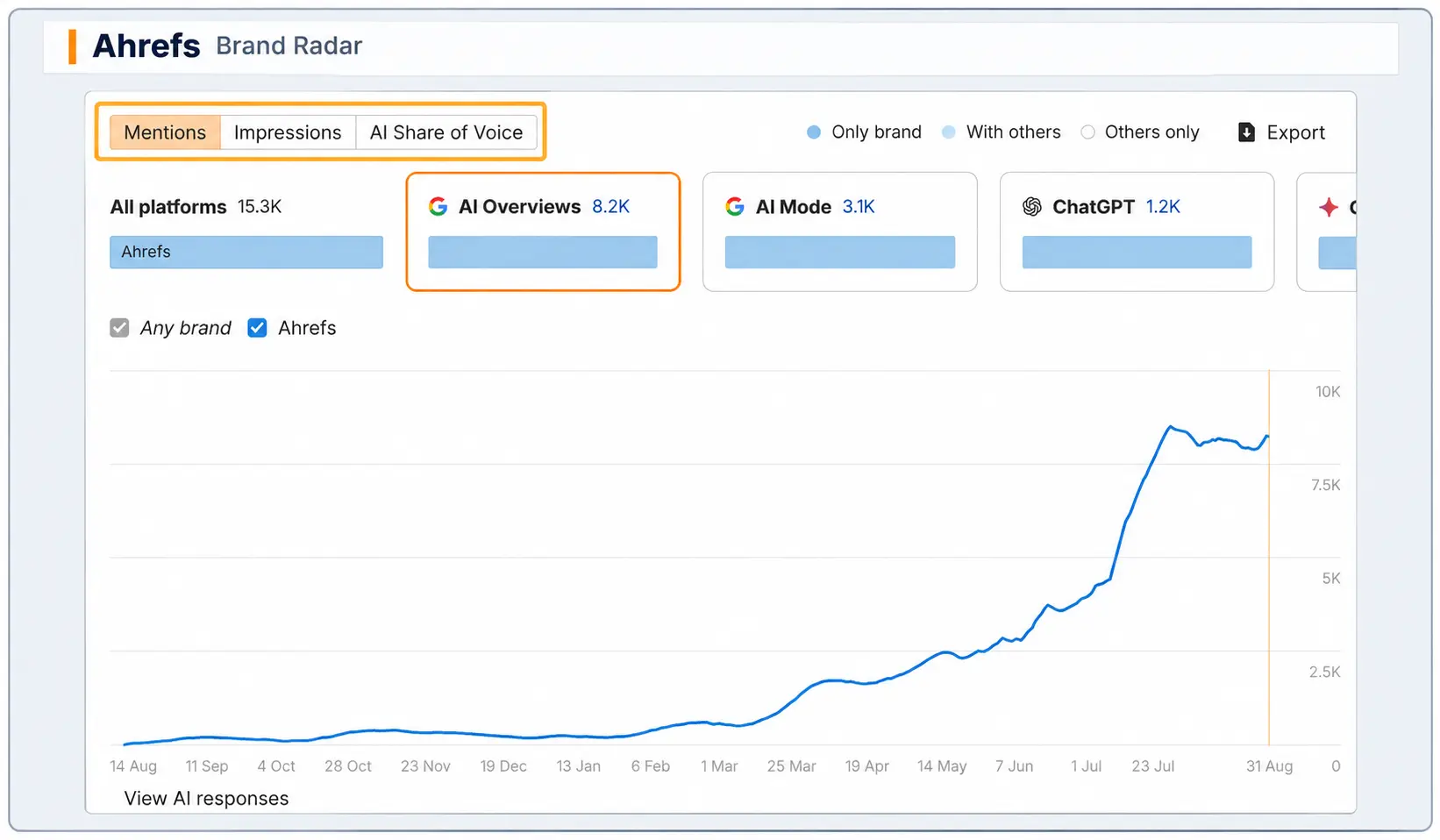
Brand Radar measures AI visibility in two ways. The AI Visibility Index lets you look up a brand or category immediately using questions Ahrefs derives from its search data. Custom Prompts tracks the exact questions you choose and starts collecting answers once you set them up.
Ahrefs plans and packages for AI visibility
| Feature | What it shows |
|---|---|
| Ahrefs Lite, Standard and Advanced | Custom Prompts included. Monthly allowances are equivalent to 5, 10 and 20 prompts checked daily on one platform in one location, respectively. |
| AI Visibility Index (one platform) | $199/mo per index. |
| AI Visibility Index (all platforms) | $699/mo, including 2,500 custom prompt checks per month. |
| Custom Prompts Basic | $50/mo for 2,500 checks, then $0.020 per additional check. |
| Custom Prompts Growth | $100/mo for 7,000 checks, then $0.015 per additional check. |
| Custom Prompts Scale | $250/mo for 25,000 checks, then $0.010 per additional check. |
One check covers one question on one platform in one location. Five questions tracked daily across three platforms in one country use about 450 checks in a 30-day month. Weekly tracking uses fewer checks and leaves room for more questions.
What's in Brand Radar
| Feature | What it shows |
|---|---|
| Brand mentions and share of voice | See how often AI answers mention your brand and compare your visibility with competitors. |
| Cited pages and domains | Find the pages AI answers link to, including third-party sites that get cited in your category. |
| Topics | Group related questions to find where competitors appear and which sources AI answers draw on. |
| Historical AI answers | Explore past answers in the index without waiting for a tracking project to collect data. |
| Custom Prompts | Track exact buyer questions by platform and location on a daily, weekly or monthly schedule. |
| Fan-out queries | See the related searches AI can run behind the scenes to answer a tracked question. |
The AI Visibility Index covers ChatGPT, Perplexity, Gemini, Copilot, Google AI Overviews and Google AI Mode. Custom Prompts also supports Claude. For a SaaS with a narrow audience, custom tracking can cover buyer questions that are missing from the index.
See the official Ahrefs custom prompt documentation for plan details.
3. Profound
- Best for
- Enterprise teams combining AI visibility reporting with marketing workflows
- Starts at
- Custom (7-day free trial)
| Pros | Cons |
|---|---|
|
|
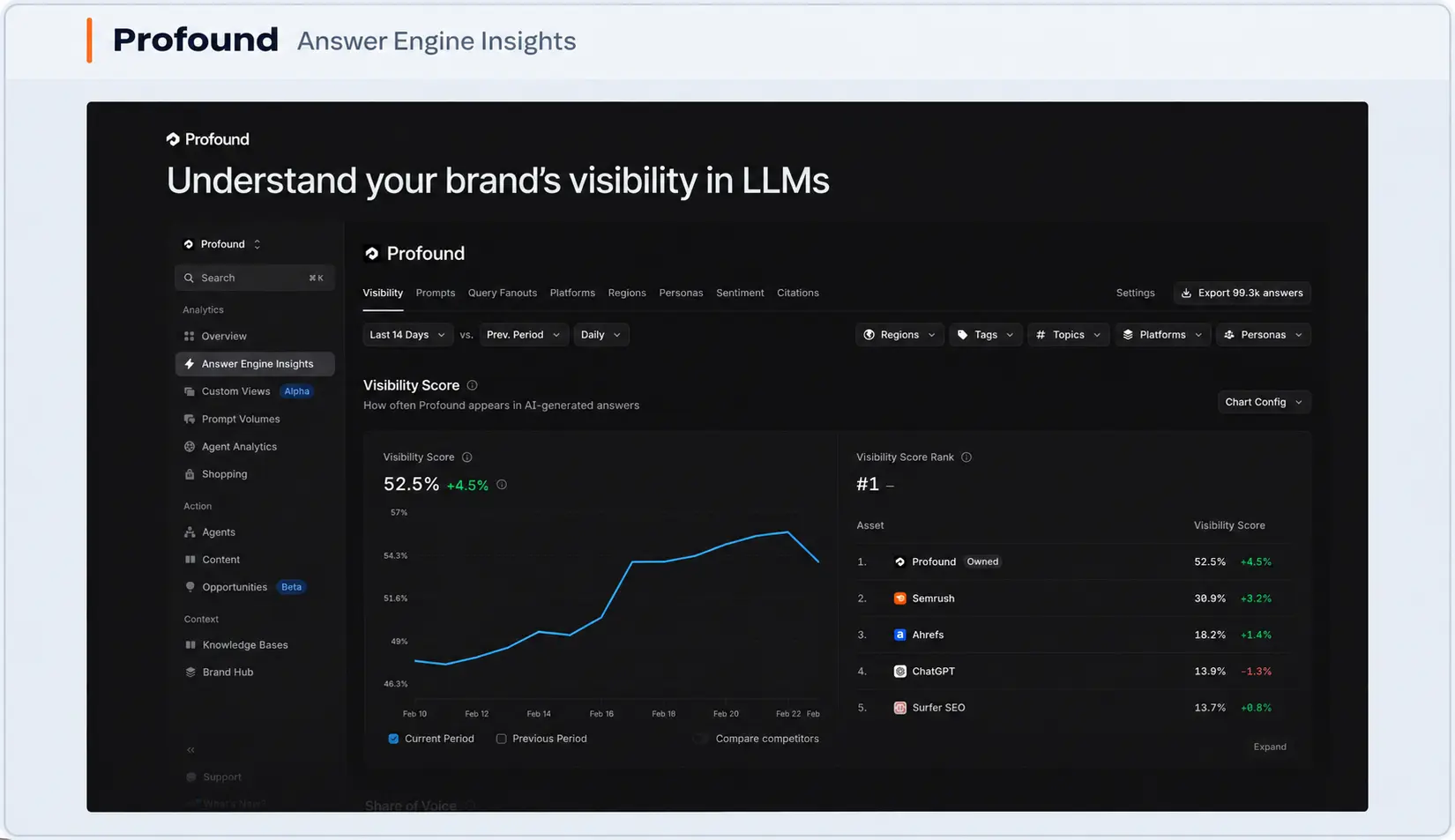
Profound runs a set of prompts daily and analyzes the answers for brand mentions, competitor visibility and citations. You can drill down to individual prompts to see where a competitor shows up and which sources the answer cites.
Plans for brands
- Free Trial. Profound runs 50 preset prompts daily for seven days across ChatGPT, Gemini and Google AI Overviews. It includes limited AI Marketer credits and five Prompt Volumes searches.
- Enterprise. Custom pricing with daily tracking across up to nine answer engines. You can choose your own prompts and tailor language and region coverage. The plan also includes exports, API access and dedicated support.
What else you can do with it
- Prompt Volumes helps you research the questions people ask AI platforms and choose topics to monitor.
- Agent Analytics tracks AI crawler visits and traffic referred by AI platforms using integrations such as Cloudflare or Google Analytics.
- AI Marketer and Agents use your brand context to draft content, summarize reports and run repeatable marketing workflows. Agent runs consume credits.
For a SaaS team that wants to track its own buyer questions over time, Enterprise is the plan to evaluate. The trial is enough to see how the reports work with Profound’s recommended prompts.
4. Peec AI
- Best for
- Marketing teams and agencies tracking prompts across brands
- Starts at
- $95/mo
| Pros | Cons |
|---|---|
|
|
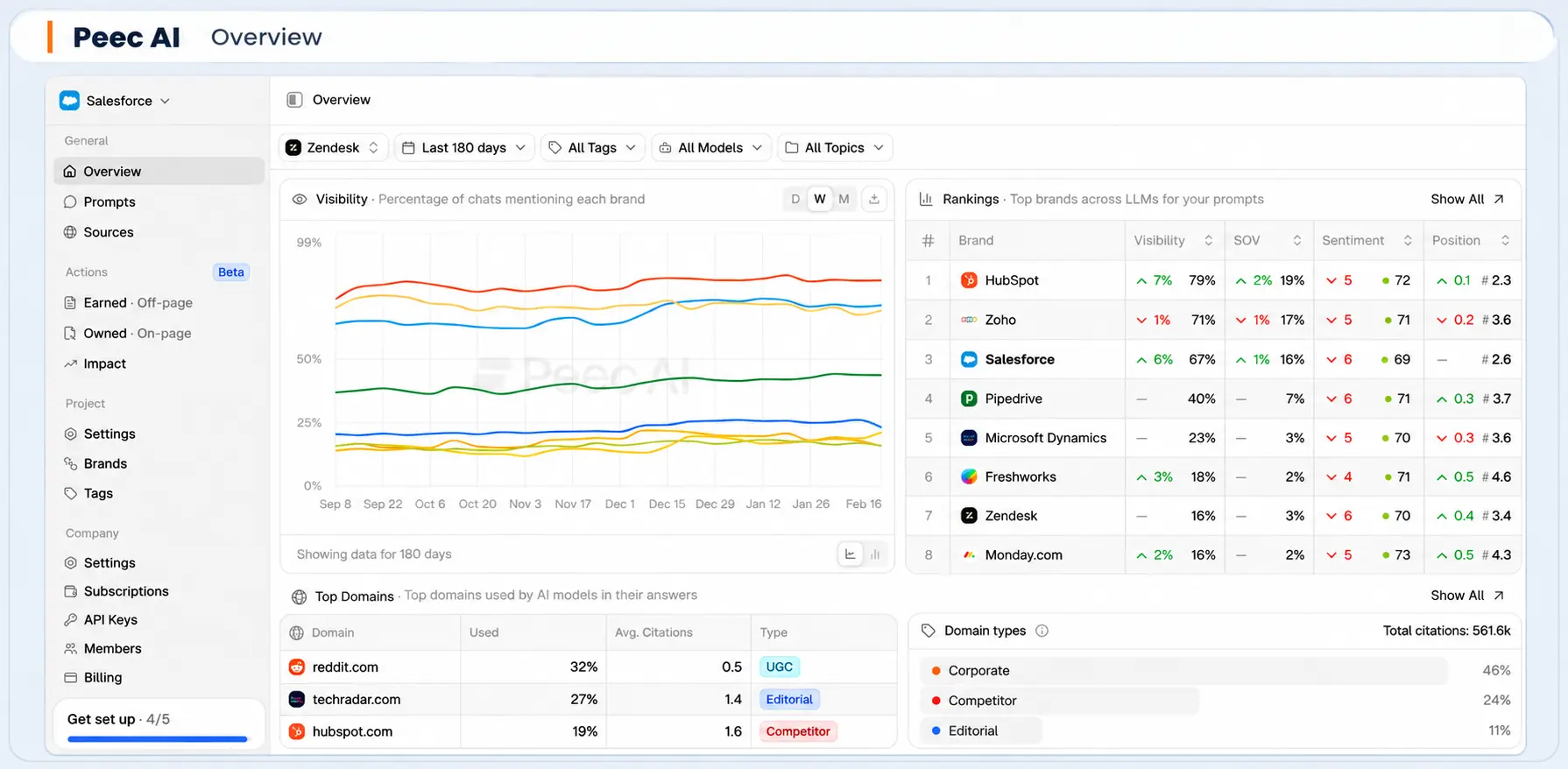
Peec AI runs your prompts on the AI platforms you select and shows how often your brand appears, how prominently it appears, and how it compares with competitors. You can open an individual prompt to see the captured answers and the domains and pages they cite.
Brand plans
- Starter ($95/mo). 50 tracked prompts and one project.
- Pro ($245/mo). 150 tracked prompts and two projects.
- Advanced ($495/mo). 350 tracked prompts, five projects, multi-country tracking and a Looker Studio integration.
- Enterprise (custom annual pricing). Tailored prompt tracking, unlimited projects and daily or weekly tracking.
Starter, Pro and Advanced run prompts daily and include three tracking models. You choose those models from the options available on your plan, which include ChatGPT, Gemini, Google AI Mode, Google AI Overviews and Microsoft Copilot. Additional models are paid add-ons. Agencies have separate plans for managing client brands.
What you can do with the data
- Visibility and competitor reporting. Compare brand mentions and average position in AI answers across the questions you track.
- Sources. See which pages and domains AI platforms use to answer specific questions, including sources that mention competitors.
- Actions. Review prioritized suggestions based on the sources AI uses, such as updating a page or pursuing coverage on a third-party site.
5. Otterly.AI
- Best for
- Small teams that want to track their own prompts across several engines
- Starts at
- $29/mo
| Pros | Cons |
|---|---|
|
|
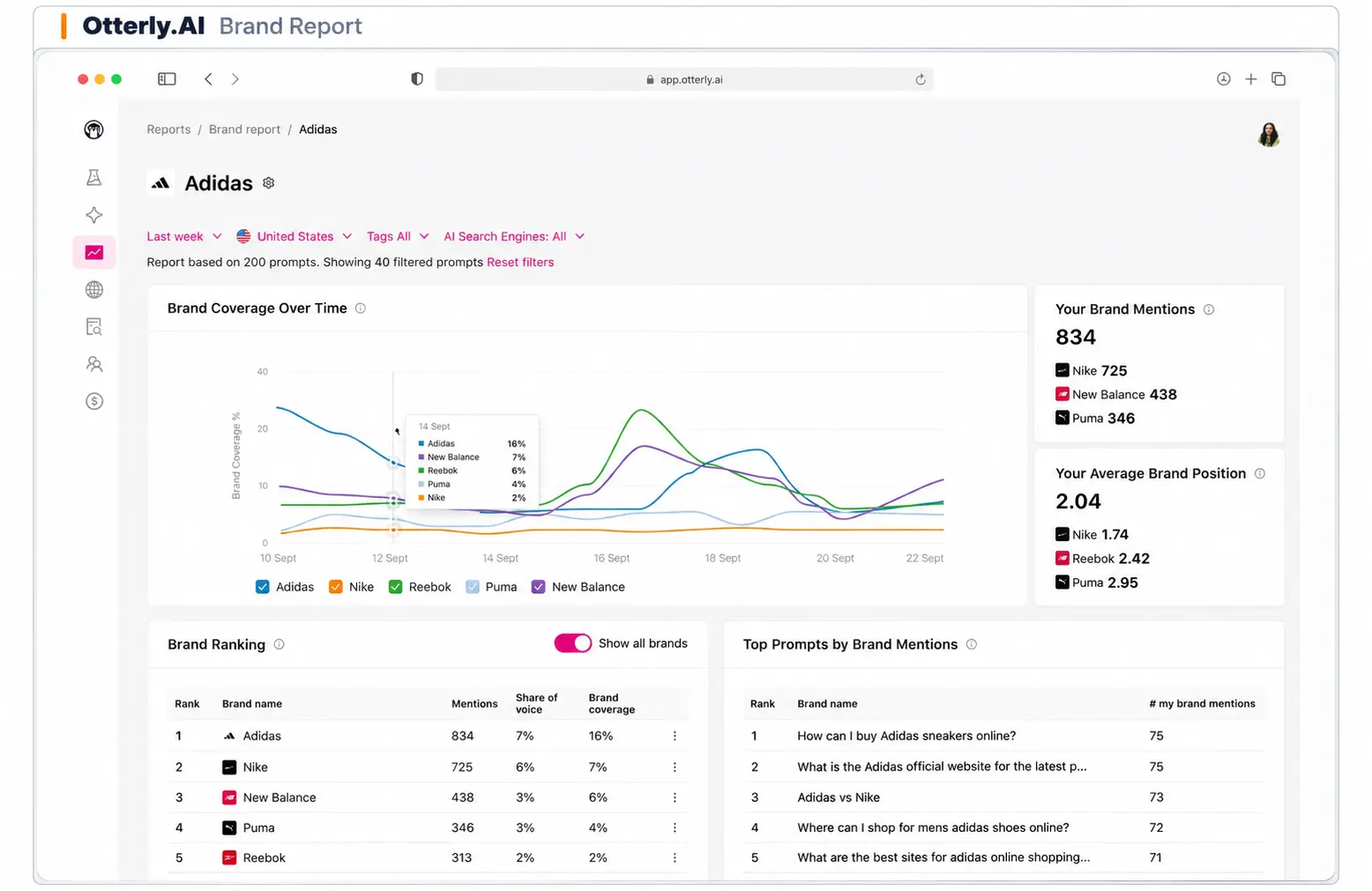
Otterly.AI monitors the questions you enter and records whether AI answers mention your brand and which links they cite. Its prompt research tool helps you turn search keywords into questions to monitor.
Plans
- Lite ($29/mo). 15 tracked prompts.
- Standard ($189/mo). 100 tracked prompts and unlimited workspaces.
- Premium ($489/mo). 400 tracked prompts and unlimited workspaces.
All three include ChatGPT, Google AI Overviews, Perplexity and Microsoft Copilot. On Lite, Gemini and Google AI Mode cost $9/mo each, and Claude costs $29/mo. Adding all three brings Lite to $76/mo. Standard and Premium can also add prompts in blocks of 100 for $99/mo.
6. ShubHQ
- Best for
- SaaS founders who want LLM visibility and SEO in one place
- Starts at
- Free or $15/mo at launch
| Pros | Cons |
|---|---|
|
|
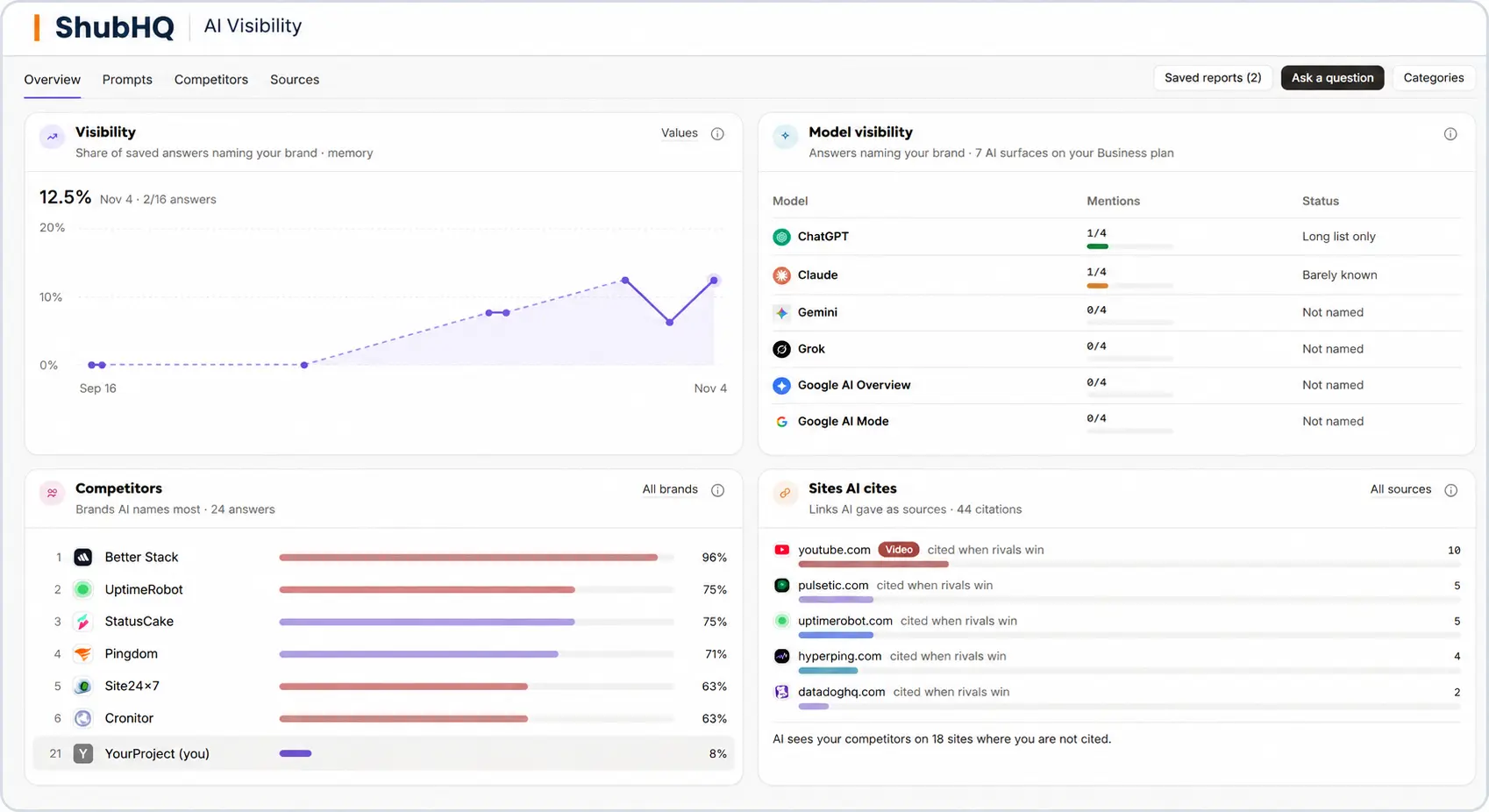
Pick a SaaS category and ShubHQ tracks buyer questions such as which tools AI recommends, what alternatives it suggests and which options fit small teams. Each category has its own results, so you can compare your visibility and share of voice against relevant rivals.
Plans
- Free ($0). One category and four AI surfaces: ChatGPT, Gemini, Grok and Google AI Overviews. The report updates when the shared category data refreshes.
- Starter ($25/mo, $15/mo for the first three months with the launch offer). Weekly checks, up to three categories, one custom prompt and Google AI Mode in addition to the four Free surfaces.
- Growth ($69/mo at the regular rate). Checks twice a week across all seven surfaces, adding Claude and Perplexity. Track up to five categories and use 20 tracking slots for custom prompts, extra categories or a mix. A prompt uses one slot and an extra category uses four.
What you can do with the data
- Compare visibility and share of voice. See where your brand and selected competitors appear by category and AI surface.
- Find cited sources on paid plans. See which pages AI cites and where those sources mention competitors.
- Plan the next growth tasks. Use AI visibility alongside Google rank tracking, backlink data and SEO audits. Growth OS brings those signals into a monthly plan.
Try ShubHQ free, or run the free LLM visibility checker first, no signup.
7. Scrunch
- Best for
- Teams that need AI visibility reporting and site audits
- Starts at
- $250/mo
| Pros | Cons |
|---|---|
|
|
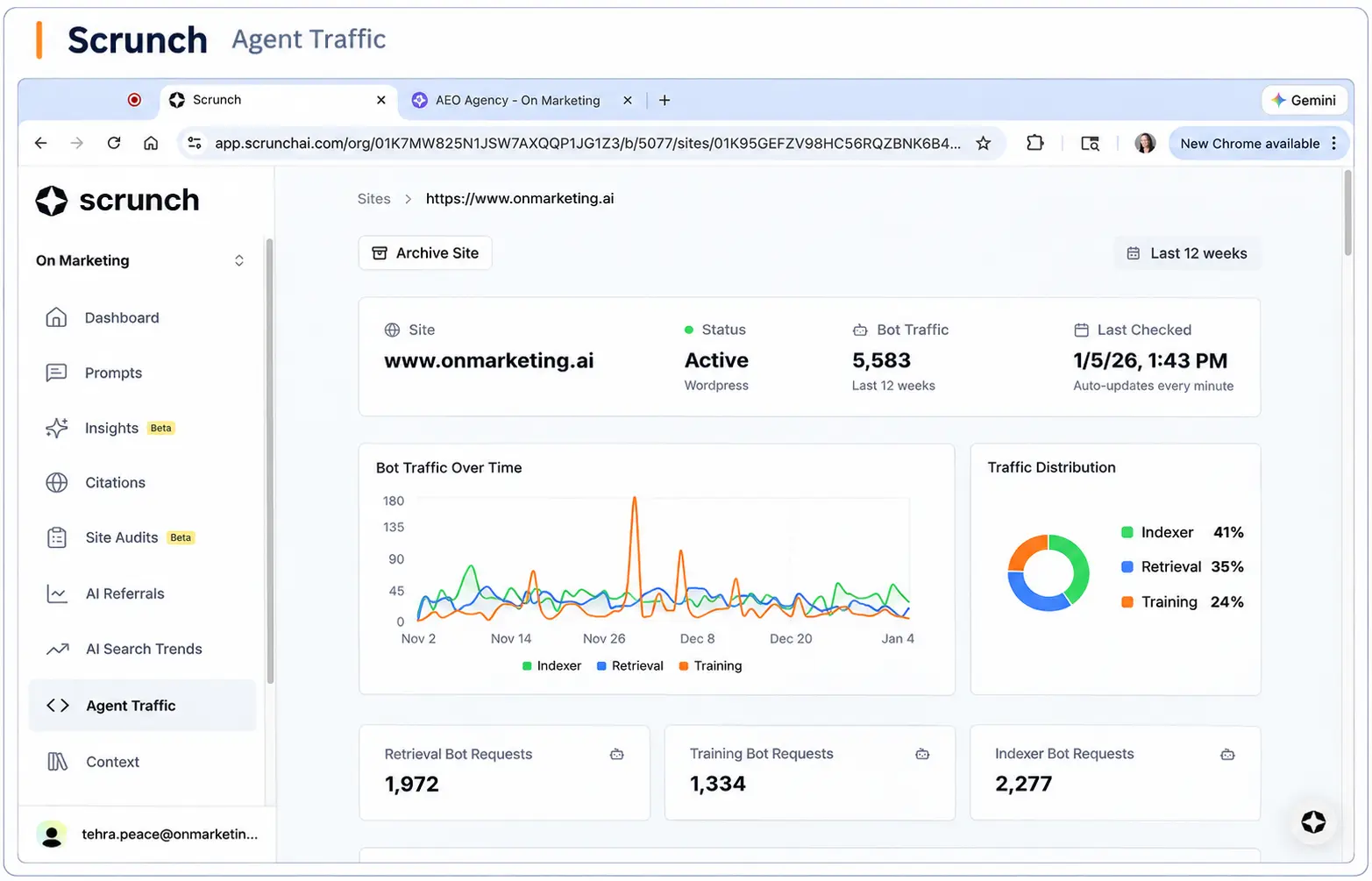
Scrunch combines prompt monitoring with site diagnostics. You can see which brands AI answers mention, which pages they cite and which AI bots visit your site. Site audits and recommendations help you decide which pages to review.
Plans
- Core ($250/mo). 125 unique prompts, 5,000 collected responses per month, five site audits per month and one brand workspace. It covers ChatGPT, Perplexity, Google AI Overviews and Microsoft Copilot. A seven-day trial is available.
- Enterprise (custom pricing). Tailored prompt and response limits, expanded site audits, API access and nine AI platforms. It also includes the Agent Experience Platform (AXP) for delivering content to AI agents.
The two Core limits measure different things. A unique prompt is a question you track. A collected response is an individual answer captured when that question runs.
8. Clearscope
- Best for
- Content teams that want to track AI mentions and improve pages
- Starts at
- $129/mo
| Pros | Cons |
|---|---|
|
|
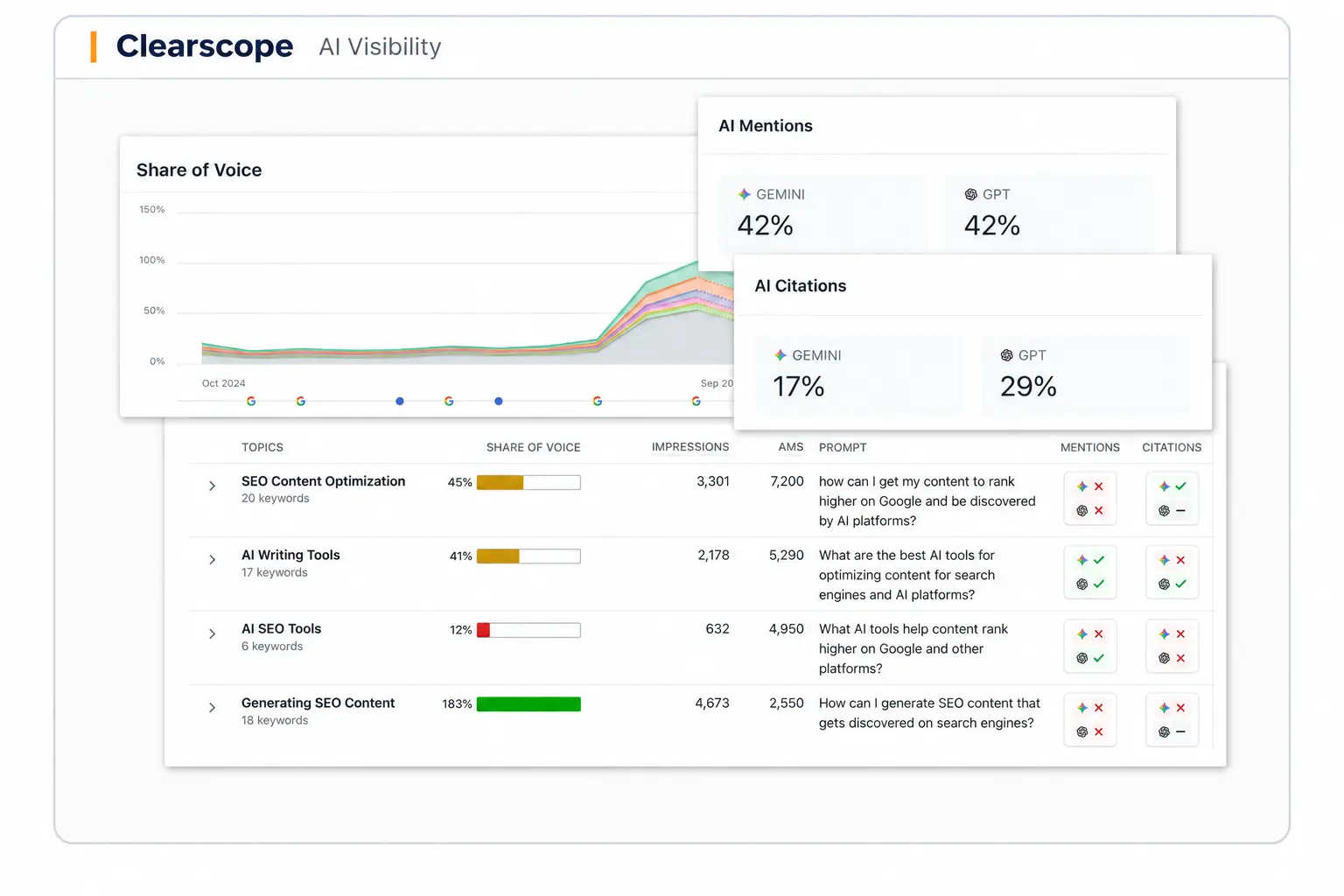
Clearscope’s Track feature compares mentions across ChatGPT, Gemini, Claude and Google. Add a buyer question and the competitors you want to watch, then open the underlying answers to see who was named. You can start a draft from the same query and monitor the page after publishing.
Plans
- Essentials ($129/mo). 50 tracked queries, 50 monitored pages, 20 Discoveries and 20 drafts per month.
- Business ($399/mo). 300 tracked queries, 300 monitored pages, 50 Discoveries and 20 drafts per month, plus a dedicated account manager.
- Enterprise (custom pricing). Business features with custom credits, crawler whitelisting and single sign-on.
Clearscope offers a 14-day free trial. Its main draw is the workflow from finding a question where a competitor gets mentioned to writing or updating a page that addresses it.
How to choose
Already on Semrush or Ahrefs?
Start with their AI add-on. Your data stays in one place.
Enterprise team?
Profound or Scrunch.
Agency with many clients?
Peec AI.
Small budget, just want a first look?
Otterly.AI Lite or ShubHQ's free plan.
SaaS founder, no growth team?
ShubHQ. LLM visibility, SEO and a monthly plan in one tool.
Whatever you pick, check two things before you pay: which AI engines are included on your plan, and how many prompts you get. Those two decide most of the bill.
FAQ
What does an LLM visibility tool do?
It asks AI assistants the questions your buyers ask and records whether your brand is named, where it appears in the list, which competitors appear instead, and which sources were cited.
Is LLM visibility the same as AI visibility?
Yes. Both mean how often AI answers mention or recommend your brand. GEO and AEO are the work you do to improve it.
Is there a free LLM visibility tool?
ShubHQ has a free plan. Most other tools offer a trial instead. For a one-off check without an account, use a free LLM visibility checker.
How many prompts do I need?
For a small SaaS, a handful of good buyer questions is enough to start: best tools in your category, alternatives to the leaders, best for small teams. Add more once you know where you stand.
How often should I check?
Weekly. AI answers change from week to week, and daily checks make you react to noise.