Competitor Analysis
Deep-dive into individual competitors with AI-powered analysis. Discover new rivals, evaluate strengths and weaknesses, and build data-driven competitive strategies.
A Comprehensive Competitive Intelligence Module
In a crowded market, knowing your competitors isn’t optional it’s survival. But manual competitor research is slow, incomplete, and quickly outdated.
Competitor Analysis is ShubHQ’s AI-powered competitive intelligence module designed to let you deeply analyze individual competitors by URL, discover new rivals you didn’t know existed, and generate multi-dimensional strategic reports covering SEO, content, market presence, brand perception, and technical infrastructure.
The module operates in two core modes:
- Analyze Competitor Enter a known competitor’s URL to generate a detailed, multi-dimensional AI analysis report.
- Discover Competitors Let AI find new competitors based on your niche and positioning, categorized and scored by relevance.
Both modes deliver AI-generated deep analysis outputs that let you see your competitor in 360° across SEO, content strategy, technology stack, market presence, and brand perception.
 Page Structure
 1. Top Tabs
The page is organized into two main tabs:
| Tab | Description |
|---|---|
| Analyze Competitor | Enter a specific competitor URL to run a deep analysis. |
| Discover Competitors | AI-powered discovery of new competitors in your niche. |
 2. Discover Competitors
This tab helps you find competitors you may not know about yet powered by AI analysis of your niche and market positioning.
Header Info Card:
| Field | Example | Description |
|---|---|---|
| Last discovery | 25.03.2026 | The date when the last discovery was run. |
| Status message | Showing saved results run again to refresh | Indicates whether results are cached or fresh. |
| Find More Competitors | Button | Triggers a new AI-powered competitor discovery scan. |
Summary:
“20 saved competitors across 4 categories. Click Find More Competitors to discover new ones.”
Shows the total number of categorized competitors and how many categories they span.
Category-Based Competitor List:
Each category groups competitors by their market approach. Example:
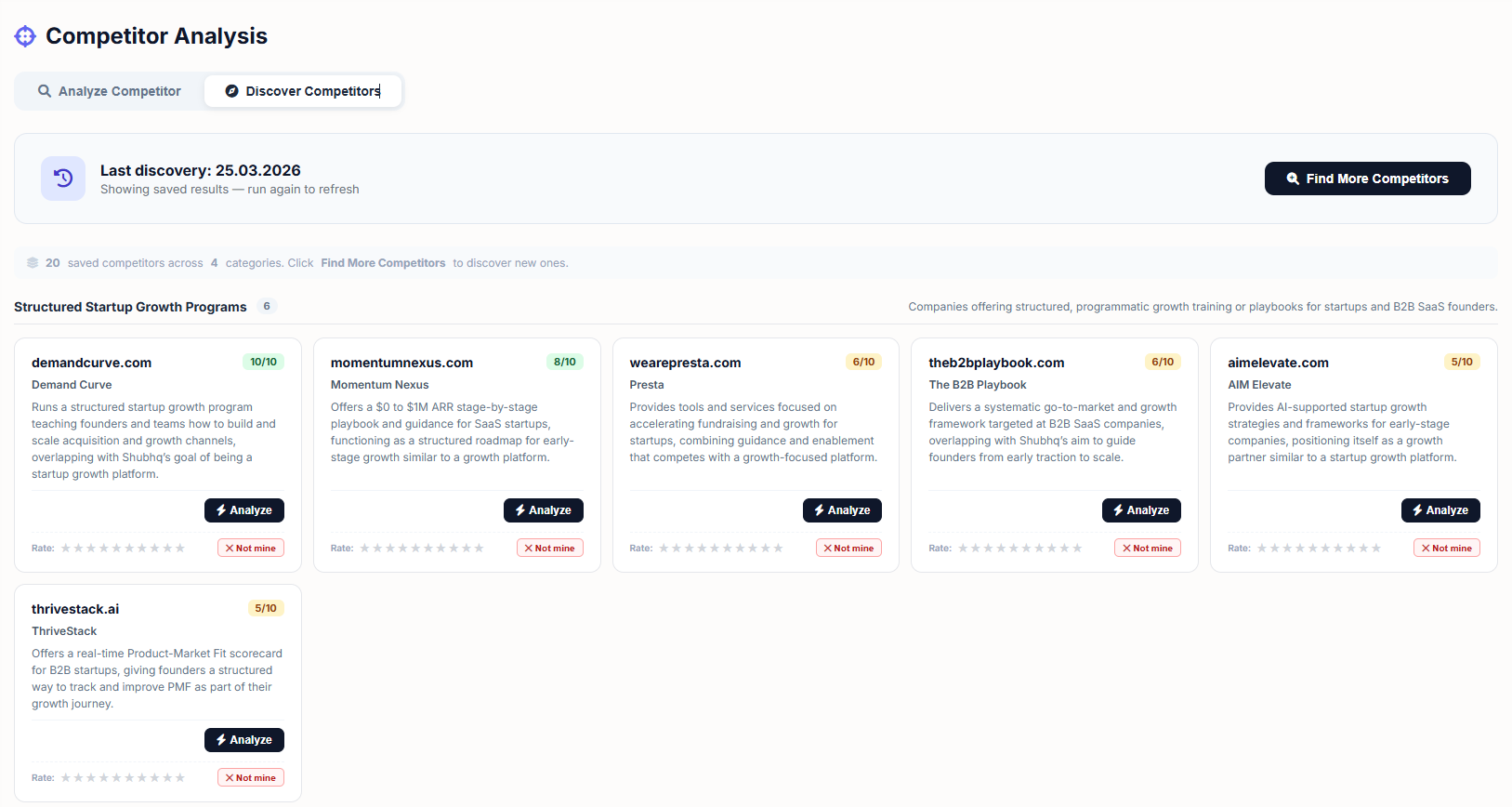
- Category title: Structured Startup Growth Programs (6)
- Description: “Companies offering structured, programmatic growth training or playbooks for startups and B2B SaaS founders.”
Competitor Card Content:
| Field | Description |
|---|---|
| Domain | The competitor’s website (e.g. demandcurve.com). |
| Company Name | The company name (e.g. Demand Curve). |
| AI Match Score | How closely the competitor matches your niche (e.g. 10/10, 8/10, 6/10). |
| AI Description | A summary of what the company does and where it overlaps with your positioning. |
Card Actions:
| Action | Description |
|---|---|
| Analyze | Run a full AI analysis on this competitor (uses Credits from your monthly allowance). |
| Rate (star) | Assign your own rating to the competitor. |
| Not mine | Mark as “not my competitor” AI will adjust future suggestions accordingly. |
Product Screenshots
The Discover Competitors tab showing saved results and the “Find More Competitors” action.
Category-based competitor list with AI Match Scores and action buttons.
 3. Analyze Competitor (Detailed Report)
When you enter a competitor URL or click Analyze from the discovery cards, a detailed report screen opens.
Top Info Bar:
| Field | Example | Description |
|---|---|---|
| Back to list | Link | Return to the competitor list. |
| Analyzed | Mar 24, 2026 | The date the analysis was performed. |
| Credits Cost | 750 Credits | The amount of Credits used from your monthly subscription allowance for this analysis. |
 Detailed Analysis Outputs
Each competitor analysis produces a multi-dimensional report covering the following sections:
 1. Niche Mismatch Detection
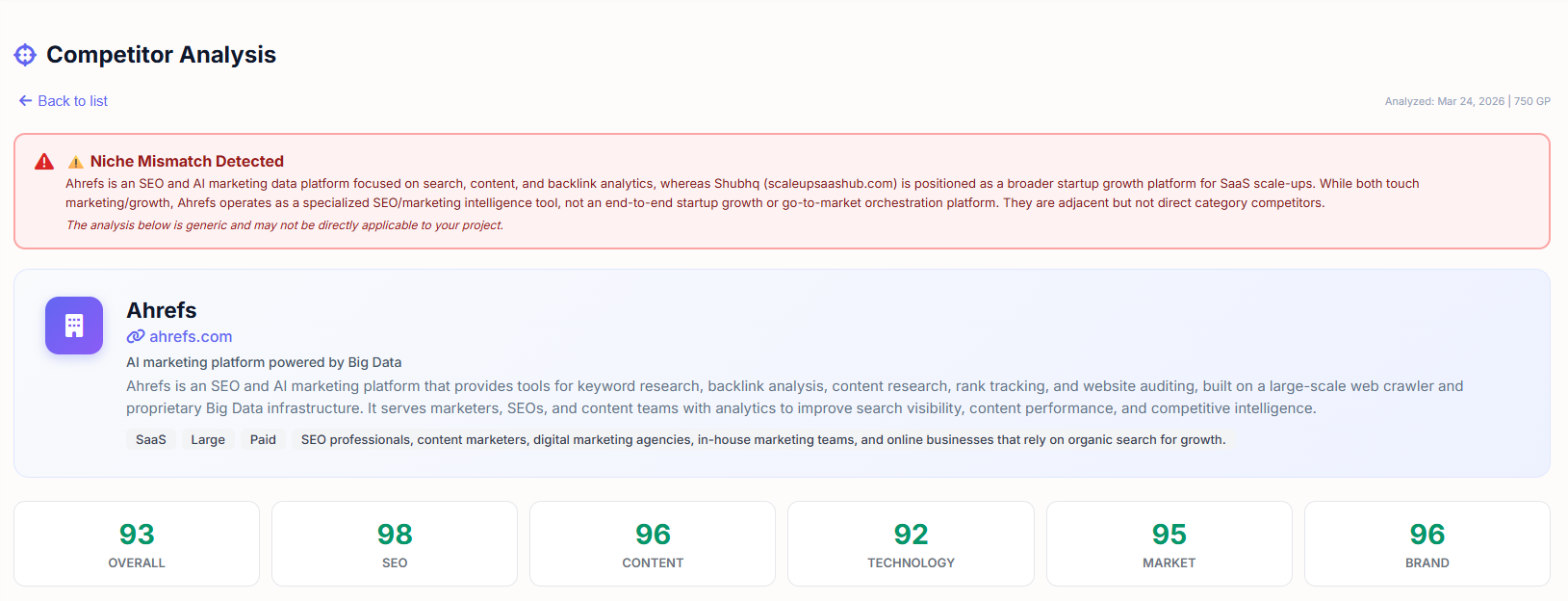
When AI determines that the analyzed competitor doesn’t directly overlap with your niche, it displays a mismatch warning.
Example:
“Ahrefs is an SEO and AI marketing data platform focused on search, content, and backlink analytics, whereas ShubHQ is positioned as a broader startup growth platform for SaaS scale-ups…”
This warning is shown for adjacent-category competitors the analysis still runs, but the insights may not be directly applicable to your niche.
 2. Company Profile Card
| Field | Example | Description |
|---|---|---|
| Logo / Brand | Ahrefs | The competitor’s brand identity. |
| Domain | ahrefs.com | Primary website domain. |
| Tagline | ”AI marketing platform powered by Big Data” | The competitor’s self-description. |
| Company Description | Full text | Core business model, products, and target audience. |
| Tags | SaaS · Large · Paid | Type, size, and business model labels. |
| Target Audience | ”SEO professionals, content marketers…” | Customer segments the competitor serves. |
Product Screenshots
Company profile card with logo, tags, and multi-dimensional score card.
 3. Score Card
The competitor’s performance is scored across six dimensions on a 0-100 scale:
| Dimension | Example | Description |
|---|---|---|
| OVERALL | 93 | Aggregate score across all dimensions. |
| SEO | 98 | Search visibility and SEO strength. |
| CONTENT | 96 | Content quality and volume. |
| TECHNOLOGY | 92 | Technical infrastructure and tool stack. |
| MARKET | 95 | Market presence and reach. |
| BRAND | 96 | Brand perception and awareness. |
 4. Strengths
The competitor’s key competitive advantages, listed as structured points.
Example:
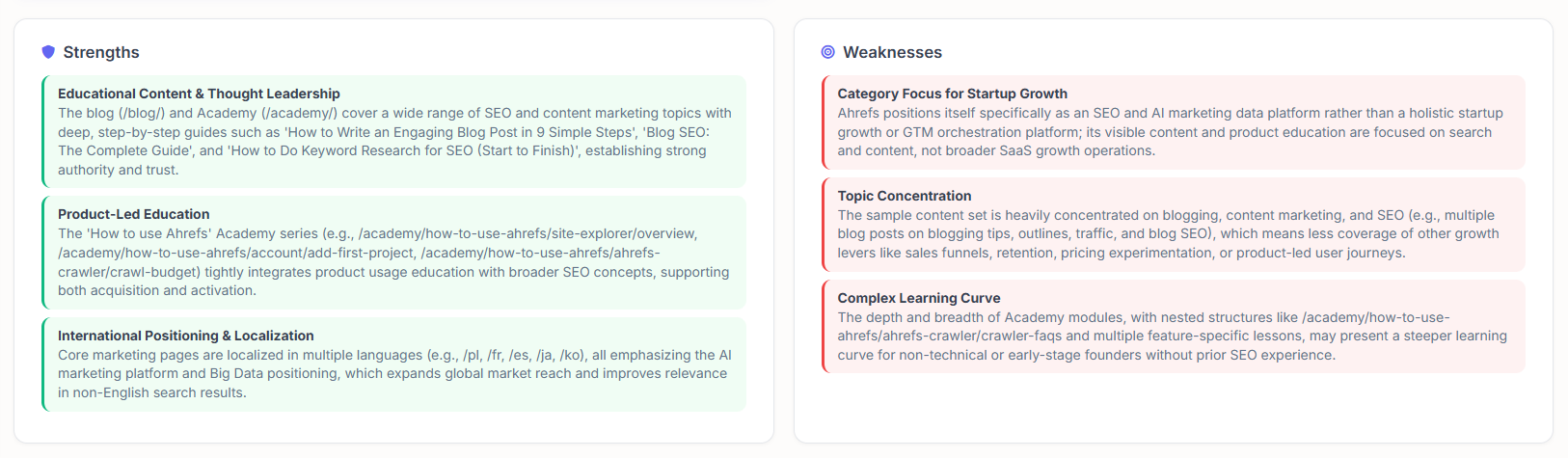
- Educational Content & Thought Leadership Deep blog and Academy structure producing authoritative content clusters.
- Product-Led Education Combines product usage with SEO education in a unified experience.
- International Positioning & Localization Multi-language support enabling global reach.
 5. Weaknesses
Areas where the competitor falls short or has limited focus.
Example:
- Category Focus for Startup Growth Narrow focus on SEO/AI marketing; weak on broader startup growth topics.
- Topic Concentration Content heavily centered around blog and SEO; sales funnels, retention, and pricing are underrepresented.
- Complex Learning Curve Academy modules present a steep learning curve for non-technical users.
 6. SEO & Backlink Profile
Core metrics reflecting the competitor’s search engine authority:
| Metric | Example | Description |
|---|---|---|
| Domain Rank | 90/100 | Domain authority score. |
| Total Backlinks | 10,000,000 | Total number of backlinks pointing to the site. |
| Referring Domains | 500,000 | Number of unique domains linking to the site. |
| Indexed Pages | 1,845 | Pages indexed by Google. |
| Blog Activity | Active / Inactive | Whether the blog is actively publishing. |
| Top Topics | SEO fundamentals, content marketing… | Primary content topics the site focuses on. |
 7. Content Analysis
A deep evaluation of the competitor’s content strategy:
| Field | Example | Description |
|---|---|---|
| Content Found | 1,845 | Total pieces of content analyzed. |
| Quality | Low / Medium / High | Overall content quality assessment. |
| Frequency | ”Frequent; the breadth of Academy modules…” | Publishing cadence and consistency. |
| Strategy | AI-generated summary | AI’s interpretation of the content strategy. |
| Content Types | Blog posts, Long-form guides, Online courses… | Formats the competitor uses. |
| Content Gaps | List of topics | Topics the competitor hasn’t covered opportunities for you. |
Product Screenshots
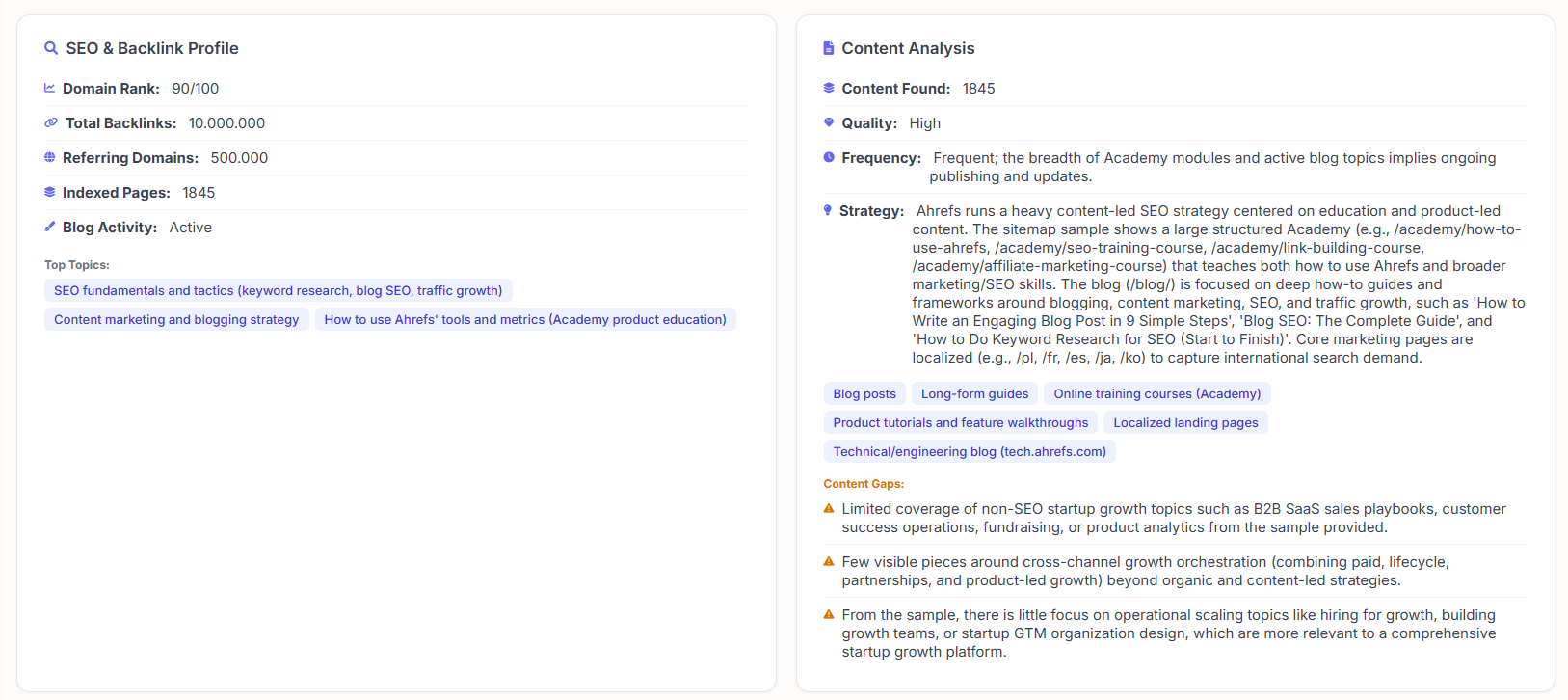
Content analysis with quality metrics, content types, and gap identification.
 8. Market Presence
The competitor’s brand perception and social visibility:
| Field | Example | Description |
|---|---|---|
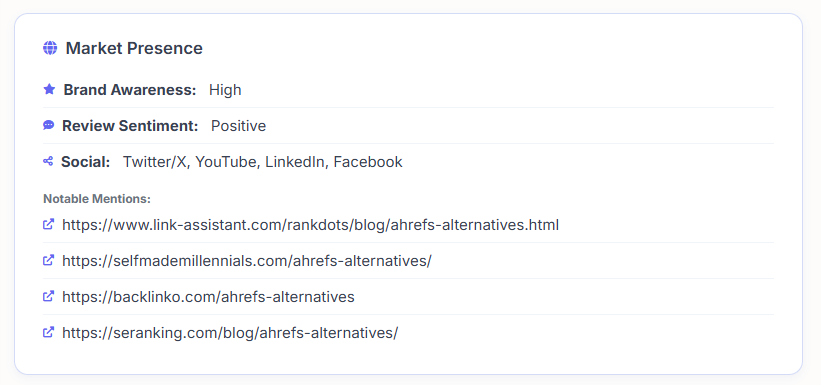
| Brand Awareness | Low / Medium / High | Overall brand recognition level. |
| Review Sentiment | Positive / Mixed / Negative | General tone of user reviews. |
| Social | Twitter/X, YouTube, LinkedIn, Facebook | Platforms where the competitor is active. |
| Notable Mentions | Links to backlinko.com, se ranking… | Authoritative sites that mention or list the competitor as an alternative. |
Product Screenshots
Market presence overview with social platforms, review sentiment, and notable mentions.
 How It Works
| Step | Description |
|---|---|
| 1. Discover or Enter | Use Discover Competitors to find new rivals, or enter a known competitor URL manually. |
 2. AI Analysis 2. AI Analysis | The system runs a deep AI analysis covering SEO, content, technology, market, and brand dimensions. |
| 3. Niche Mismatch Detection | AI determines whether the competitor directly overlaps with your niche and warns you if not. |
| 4. Multi-Dimensional Scoring | Scores are generated across SEO, content, technology, market, and brand (0-100 each). |
| 5. Strengths / Weaknesses / Gaps | The competitor’s advantages, gaps, and content opportunities are listed. |
| 6. Take Action | Turn content gaps into opportunities, weaknesses into your positioning strengths, and strong areas into learning targets. |
Use Cases
| Use Case | What You Gain |
|---|---|
| Niche Market Entry Planning | Learn who you’ll compete against before entering a new market. |
| Content Gap Hunting | Identify topics competitors haven’t covered and focus your content there. |
| SEO Targeting | See competitor Domain Rank and backlink profiles to set achievable targets. |
| Positioning Strategy | Turn competitor weaknesses into your strongest messaging. |
| Mention Tracking | Find “alternatives” lists where competitors appear and plan outreach to get listed. |
| Investor Presentations | Include competitive analysis as a structured report in your pitch deck. |
 Annual Strategy Meetings Annual Strategy Meetings | Refresh your competitor list 2-4 times per year to keep your market map current. |
 Plans & Limits
| Resource | Description |
|---|---|
| Credits per Analysis | Each detailed analysis uses a set amount of Credits from your monthly allowance (e.g. 750 Credits). |
| Discover Competitors | Daily/weekly discovery limits based on your plan tier. |
| Saved Competitors | Stored by category; revisit without re-analyzing. |
| Niche Mismatch Detection | Automatically active on all plans. |
 Roadmap Planned Modules
The following advanced modules are planned to transform Competitor Analysis into a full strategic command center:
Side-by-Side Comparison Module
Compare 2-4 competitors across all metrics (SEO, content, brand) in a single table.
- Include your own site in the comparison.
- Automatic winner/loser highlighting per row.
Trend & Timeline Tracking
Track how a competitor’s Domain Rank, backlinks, and content volume change over time.
- Monthly snapshots to monitor growth/decline trends.
- “Which competitor grew fastest in the last 6 months?” ranking.
New Content & Page Watcher
Instant notification when a competitor publishes a new blog post, landing page, or feature page.
- Auto-extract target keywords from new pages.
- View competitor’s weekly content calendar.
Backlink Movement Tracker
Track new backlinks gained or lost by competitors.
- “This week, competitor gained 50 new backlinks from these sites.”
- Identify backlink opportunities from the same sources.
Keyword Overlap Analysis
Extract shared keywords where both you and the competitor rank.
- List keywords the competitor ranks for but you don’t (keyword gap).
- Prioritize keywords with the smallest ranking difference as immediate targets.
Pricing & Package Tracker
Automatically detect changes on competitor pricing pages.
- Track new packages, price increases, and discount campaigns.
- Historical pricing change graph.
Ad Intelligence
View competitor ads running on Google Ads, Meta Ads, and LinkedIn Ads.
- Analyze messaging, targeting, and audience segments.
- Active campaign estimation and budget signals.
Social Media Activity Score
Track follower growth, posting frequency, and engagement rates across Twitter, LinkedIn, and YouTube.
- Capture competitor viral posts.
- Social media visual/format analysis.
Tech Stack Detail
List of analytics, CMS, A/B testing, chatbot, and other tools the competitor uses.
- BuiltWith / Wappalyzer-style automatic technology detection.
- Inferences like “This competitor uses HubSpot indicating an inbound strategy.”
Review & Testimonial Aggregator
Pull all competitor reviews from G2, Capterra, Trustpilot, Reddit, and Twitter.
- List top user complaints as weakness opportunities.
- Sentiment analysis with positive/negative/neutral ratios.
AI Strategy Recommender
Generate a personalized action plan based on competitor weaknesses and content gaps.
- “5 priority moves for the next 30 days.”
- Recommendations on content, backlinks, and marketing campaigns to launch.
Automated Weekly / Monthly Reports
Automatic report emails for selected competitors on a weekly or monthly cadence.
- “12 things that changed at your competitor this week.”
- PDF / Notion / Google Docs integration.
CTA & Messaging Analysis
Analyze competitor homepage hero headlines, CTA buttons, and value propositions.
- Tone, audience language, and emotional emphasis analysis.
- Side-by-side comparison table with your own messaging.
Content Performance Prediction
Estimate which of the competitor’s recent content pieces are driving traffic.
- Top 10 performing content pieces: title, format, and length analysis.
- “Best content format for you” recommendation based on competitor data.
Customer / User Profile Analysis
Extract customer segments from competitor logos, case studies, and testimonials.
- Insights like “This competitor primarily sells to SaaS startups.”
- Suggest potential customer leads from the same industry.
Competitor Watchlist & Alert System
Add specific competitors to a priority watchlist.
- Instant Telegram notification for major changes (new feature, price increase, viral content).
- Weekly summary digest.
Comparative Brand Health Score
Compare brand awareness, sentiment, and social media impact between you and your competitors.
- Monthly brand health trends.
- Auto-recommend actions for areas where you’re falling behind.
Niche Map (Competitor Map)
Visualize all competitors on a 2D chart (e.g. price × feature breadth).
- Identify crowded and empty zones in the market.
- Plot your own brand positioning on the map.
Outreach Logbook Integration
One-click add Notable Mentions sites from competitor analysis to your outreach logbook.
- Use competitor backlink sources as potential outreach targets.
- “These sites link to your competitor they could link to you too” smart list.
Multi-Account & Team Notes
Allow multiple team members to add comments, notes, and tasks for the same competitor.
- “@teammate this strength is also a gap for us let’s address it.”
- Competitor rating polls across team members.
The Bottom Line
Competitor Analysis is a comprehensive competitive intelligence center from deep-diving into a single competitor to AI-powered discovery of new rivals.
| What You Get | Why It Matters |
|---|---|
| AI-powered competitor discovery | Find rivals you didn’t know existed |
| Niche Mismatch Detection | Avoid misleading comparisons |
| Multi-dimensional scoring | See SEO, content, tech, market, and brand at a glance |
| Strengths & Weaknesses mapping | Understand where competitors win and where they don’t |
| Content Gap identification | Find topics to own before your competitors do |
| SEO & Backlink Profile | Measure technical authority and link-building power |
| Market Presence evaluation | Assess brand perception and social visibility |
Our roadmap includes side-by-side comparison, trend tracking, new content watchers, backlink movement alerts, AI strategy recommender, ad intelligence, and outreach integration all designed to make this page a weekly strategic habit for competitive intelligence.
Get Started
Ready to start analyzing your competition?
- Navigate to Competitor Analysis from your dashboard
- Switch to the Discover Competitors tab to let AI find rivals in your niche
- Use Analyze on any competitor card to generate a deep report
- Or enter a known competitor URL directly in the Analyze Competitor tab
- Review the score card, strengths, weaknesses, and content gaps
- Mark irrelevant suggestions as Not mine to improve future recommendations
Happy analyzing!